The SUV market in India is moving beyond a mere focus on power and design, moving towards a new phase one that is based on the intelligent management of energy. Users no longer have to balance performance and efficiency. They want both. The auto industry is finally making good on its promises.
Upcoming petrol and hybrid SUVs are indeed exciting with their electric range and fuel efficiency options as they range from plug-in hybrids with triple-digit electric ranges to strong hybrid crossovers with 35+ kmpl. Let’s take a detailed look at the models that are important and what they offer.
Why Petrol-Hybrid SUVs (PHEVs) Are Increasing Fast
The change is occurring because of obvious reasons. Gas prices are volatile, inner-city driving reduces mileage and EV charging infrastructure is still underdeveloped for those who drive on the highway. The petrol hybrid SUV addresses all three problems. You have all the benefits of a petrol engine on longer journeys, the benefits of an electric motor in urban driving and none of the range anxiety that full EVs have in many areas of India.
In addition, the government is looking at revamped GST structures which are more favourable for cleaner hybrid technology, making owning the technology more cost-effective in the future. The manufacturers have listened, and in the coming 18 months, the hybrid SUV market would see the biggest push in terms of vehicles it’s seeing in India.
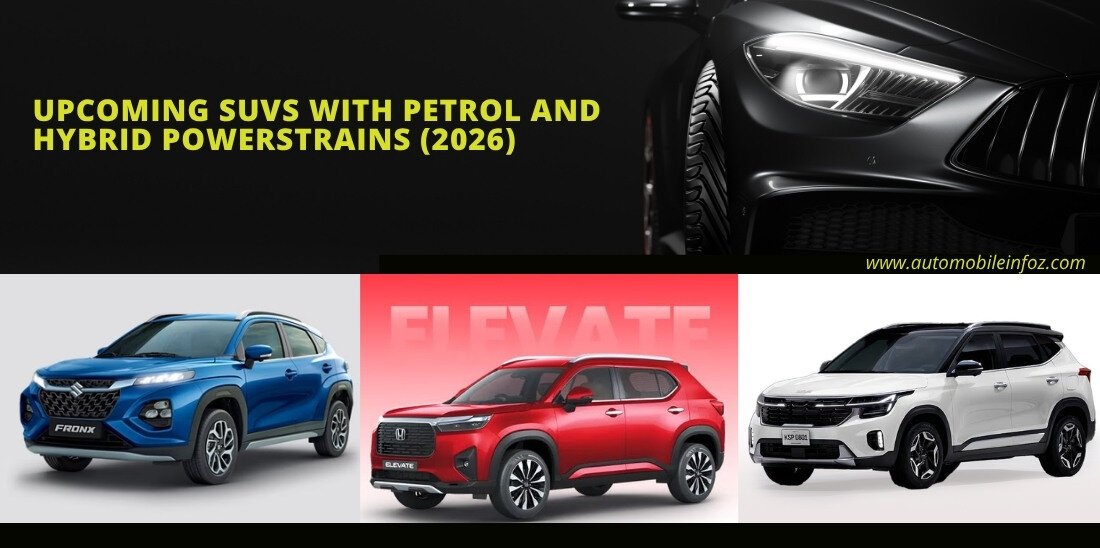
Maruti Fronx Hybrid (Strong Hybrid at an Accessible Price)
Maruti Suzuki will make hybrid cars commonplace with its Fronx Hybrid set to go on sale in 2026. The SUV will be equipped with the company’s newly developed in-house 1.2-litre, three-cylinder Z12 engine coupled with a complete strong hybrid system. The estimates indicate that the car will be able to achieve an efficiency greater than 35 km per litre which will make it one of the more economical petrol-hybrid crossovers in the country.
The hybrid Fronx will look similar to the current petrol Fronx, although it will have the distinctive hybrid badging. With Maruti’s track record of providing exceptional service to customers and competitive pricing, it is likely that this model will appeal to the first-time hybrid car owners in this country immensely. The next generation Baleno is also getting the Z12-based powerplant.
Honda Elevate Hybrid: Efficiency with Premium Services
The Honda Elevate Hybrid delivers the same efficiency as the Honda Accord, but with premium intent.
At its Tapukara plant in Rajasthan, Honda is readying up its first hybrid SUV for India, which will be launched in the second half of 2026. The Elevate Hybrid is likely to be powered by the same Atkinson-cycle 1.5-litre four-cylinder petrol-hybrid engine that is present on the City e:HEV with two electric motors. One of Honda’s strengths with the hybrid system is its ability to provide excellent fuel economy in real-world driving conditions, especially in stop and go city driving.
At likely 26 kmpl and with its refinement Honda hybrids are renowned, the Elevate Hybrid is a high-quality, but non-exotic, midsize SUV for those that wish to upgrade from the traditional petrol model—even if they don’t quite want to go all the way with the electric.
Kia Seltos Hybrid: A Generation Upgrade
The all-new Kia Seltos is one of the most anticipated midsize SUVs to launch in the short-term. The new Seltos was launched worldwide late in 2025 and also launched in India early in 2026, whereas the hybrid version has been confirmed for 2027. It is rumored to use a 1.6-litre petrol engine teamed with an electric motor, which could push the car’s efficiency as high as 30 kmpl, one of the highest in the class.
The new Seltos is actually inspired by the Kia EV5 concept car in terms of design, and is getting a more futuristic front fascia with an alleged 30-inch, panoramic display on the inside. Further, it is expected that the seats will be rear-ventilated and that ADAS will be improved. Those who are willing to wait for the hybrid version should be able to get the fullest version of this SUV.
Renault Duster Hybrid — A Good Return
The third-generation Duster is the latest in Renault’s resurgence in India, and the hybrid is a crucial component of its efforts. The petrol Duster will be launched on the CMF-B platform in early 2026 and the hybrid version is expected to be launched by the Diwali 2026 timeframe.
The Duster Hybrid will be mated to its 1.8-litre naturally aspirated petrol engine and two electric motors, one of which will act as a generator and the other that will drive the wheels, with a 1.4kWh battery pack. When combined, it’s 160 bhp and 172 Nm of torque. This is the type of arrangement that is meant for real world efficiency, as opposed to just badge. A Duster variant with the seating capacity of 7 is due to be created as well, inspired by the Dacia Bigster.
Mahindra XUV3XO Hybrid — Home-Grown Goes Green
Mahindra’s next-generation compact SUV, the XUV3XO will be hybrid from around 2026, which will be the brand’s maiden venture into petrol-hybrid SUVs. The combination will be a 1.2-litre turbocharged petrol engine mated to a hybrid system, to offset any loss of zest in the city that the XUV3XO is well known for.
Mahindra has also introduced its new NU-IQ flexible platform, that is capable of supporting hybrid, petrol, CNG and electric powertrains. So, if future Mahindra SUVs are to get progressively hybridized then it’ll probably happen across the board, not just on the 3XO.
JSW Motors Jetour T2 — Plug-In Hybrid Enters the Ring
The most technologically advanced upcoming launch will be Jetour T2, also known as Traveller C-DM which will be the first time JSW motors will go on sale for a passenger vehicle in India. The length of this D-segment PHEV is 4,785 mm and its wheelbase is 2,800 mm, which is definitely in the territory of large SUVs.
The powertrain is a 1.5-litre turbocharged petrol engine delivering 154 bhp alongside a pair of electric motors that deliver a total of 221 bhp. Inside, the T2 has a 15.6-inch touchscreen, a 10.25-inch digital cluster with 50W wireless charging, a 360-degree camera, ventilated front seats and a 580-litre boot. It will be sold at a rate of Rs 25 to 32 lakh, and will be a direct competitor to the Mahindra XUV 7XO and Tata Safari.
A Few Items That Buyers Should Be Aware Of Prior To Selection
Let’s take a look at some of the factors that should be considered when comparing these new models:
Hybrids (such as the Fronx and Elevate) are strong, and are not plugged in, but charge the battery through regenerative braking. Other PHEVs, such as the Jetour T2, can be connected to an external charger to give an extended electric-only range.
Strong hybrids, with high electric motor contribution, will be most useful to people commuting most of the way to and from the city. Fuel savings might not be as noticeable on highway driving.
To get the best out of a PHEV, buyers must have access to home charging stations or have a highly reliable public charging station. If the vehicle is not regularly charged, the PHEV operates as a standard petrol powered SUV.
The maturity of the service network is an important factor — new players such as JSW Motors have limited reach of their service network while the established ones such as Maruti and Honda are well established and have a wide spread of services.
Conclusion
The upcoming 18 months will redefine the expectations of Indian SUV buyers from petrol cars. From Maruti’s introduction of affordable strong hybrid tech to the compact segment, Honda and Kia’s range enhancement of their midsize cars, to JSW Motors’ arrival of plug-in capability that is on par with dedicated EVs, there are more and cleverer choices than ever. Those looking to make the leap from a traditional petrol SUV to a more suitable option can now make an informed decision.
FAQs
Standard hybrid SUVs (strong hybrid) can only be charged through regenerative braking and do not have an external charging port. A plug-in hybrid (PHEV), such as the Jetour T2, is equipped with a bigger battery which can be recharged at a charging point, providing a greater range in electric mode before switching to petrol mode.
Considering the estimates available, the mileage of the Maruti Fronx Hybrid is estimated to be higher than all other compact SUVs, with it being over 35 kmpl. The Kia Seltos Hybrid will be available in 2027 and in the midsize segment, the Seltos can achieve up to 30 kmpl.
Renault Duster Hybrid is powered by a 1.8-litre petrol engine, a pair of electric motors and a 1.4 kWh battery pack, which is fully self-charging. It’s not a plug-in hybrid. Overall, the system offers 160 bhp, with a focus towards achieving an urban efficiency.
Honda Elevate Hybrid is expected to roll out in the second half of 2026. The production is to be started at Honda’s Tapukara plant in Rajasthan. The official launch date by Honda India is yet to be announced.
Renault is to introduce a seven-seater version of the Duster, inspired by the Dacia Bigster. It will be based on the same platform, feature set and powertrain as the 5-seater Duster, and will likely have a new nameplate when it launches.
Also, Read About –
15 Upcoming Chinese Cars Expected To Launch In India In 2026