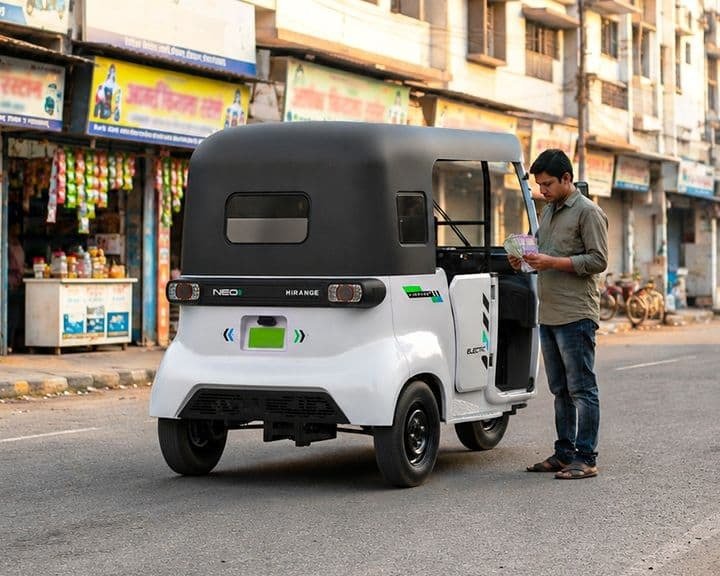
If you’ve been anywhere near an auto stand lately, you’ve probably heard drivers talking about NEO by Euler. It’s the new electric auto-rickshaw brand from Euler Motors, a company that until recently was known mostly for cargo EVs. Now they’ve stepped into passenger transport, and the price tag, ₹3,09,999 for the entry variant, has people asking the obvious question: is it actually worth it compared to a regular CNG auto?
Let’s go through this properly instead of just comparing sticker prices.
The Upfront Cost Gap Is Real
There’s no getting around it. A CNG auto costs noticeably less to buy than the NEO HiRANGE. That’s just where the market sits right now for electric three-wheelers in India. If you’re a first-time buyer working with a tight budget, that gap matters, and it’s probably the single biggest thing holding people back from switching.
But a lower purchase price only tells part of the story, especially for someone who plans to drive this vehicle for years and treat it as a livelihood, not just a one-time purchase.
What You Actually Get for ₹3.1 Lakh
The NEO HiRANGE comes in three variants, and the range numbers are worth paying attention to. The top variant is ARAI-certified for 261 km on a single charge, with the other two variants rated lower depending on battery size. In real-world daily use, that typically works out to somewhere in the 130 to 200+ km range across the lineup, which is enough for a full working day for most drivers without needing a mid-shift charge.
Charging itself takes about 3.25 hours to go from 10% to 80%, which isn’t instant, but it’s manageable if a driver charges overnight or during a break.
The build includes a few things worth noting: a skateboard chassis design, a 9 kW motor putting out 65 Nm of torque, hill-assist, real-time diagnostics, and anti-theft GPS. None of these are flashy extras. They’re the kind of practical features that matter to someone using the vehicle for eight or ten hours a day, every day.
There’s also a 6-year or 1.75 lakh km warranty, which is significant. That’s a long runway of coverage compared to what most traditional autos come with, and it takes some of the risk out of a bigger upfront purchase.
Where CNG Still Holds an Edge
CNG autos aren’t going away anytime soon, and for good reason. The refuelling infrastructure is everywhere. You pull into a CNG station, fill up in a few minutes, and you’re back on the road. There’s no waiting around for a charge, no planning your day around when and where you’ll top up.
CNG autos are also generally cheaper to buy, which matters a lot for someone just starting out or working with limited capital. And mechanics who know how to service and repair CNG autos are easy to find in almost every city, which isn’t yet true everywhere for electric three-wheelers, especially in smaller towns.
Running Costs: Where Electric Starts Pulling Ahead
This is really where the comparison shifts in NEO’s favor. Electric vehicles cost less to run per kilometre than CNG in most cases, since electricity is generally cheaper than compressed gas on a per-km basis. Over months of daily driving, that difference adds up in a way that starts to offset the higher purchase price.
Maintenance is the other big piece. A CNG auto has an engine with all the usual wear items, oil changes, spark plugs, clutch wear, and periodic servicing. The NEO HiRANGE, like most electric vehicles, skips most of that because there’s no combustion engine involved. Fewer moving parts generally means fewer trips to the mechanic and lower repair bills over time.
So, Is It Worth It?
Here’s the honest answer: it depends on how you’re using the vehicle and how far ahead you’re willing to look.
If you need a vehicle today, have a tight budget, and want the simplicity of instant refuelling without thinking twice, a CNG auto is still the easier, lower-risk choice, especially outside major cities where EV service networks are still catching up.
If you’re driving long hours daily, plan to keep the vehicle for several years, and can absorb the higher upfront cost, the NEO HiRANGE starts to make a lot of sense. Lower running costs, less time lost to maintenance, and a strong warranty period work in its favor over the life of the vehicle. For drivers thinking in terms of total earnings over five or six years rather than just the price on day one, ₹3.1 lakh isn’t necessarily expensive, it might just be the cost of fewer headaches down the road.