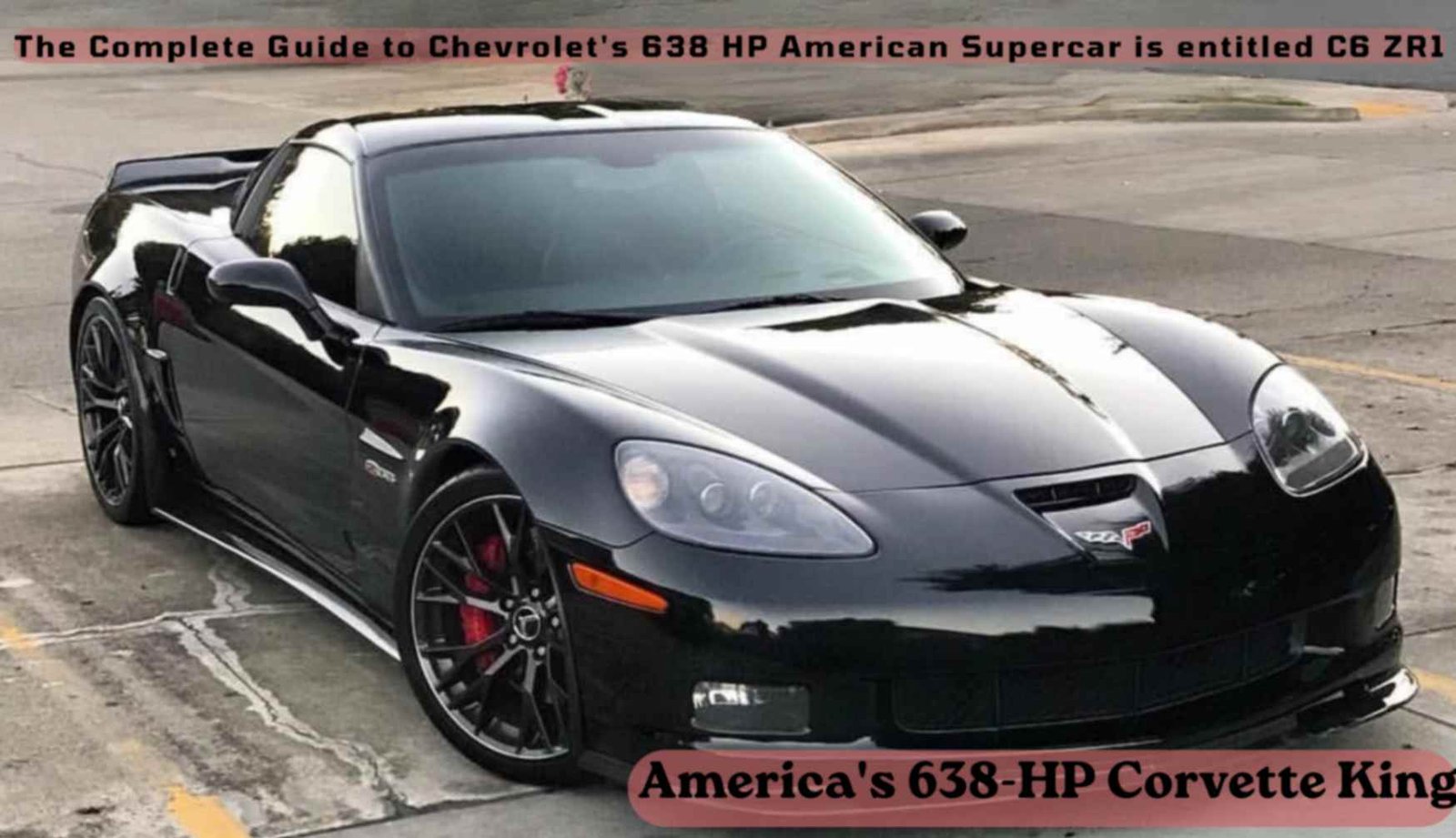
When it debuted,the C6 ZR1 was the quickest and most powerful Corvette that’s ever made. Constructed from 2009-13 and equipped with a supercharged 638 hp V8, a speed of 205 mph and a $100,000 price tag, the vehicle truly made Chevrolet a super car. On the day of its debut, it was the highest-performance car in General Motors’ production history. It was more importantly a proof that an American sports car could compete with Ferrari and Porsche on equal terms. This guide describes the reasons for the C6 ZR1’s uniqueness, its capabilities, what was changed annually and the current price of one.
What Is the C6 ZR1?
The ZR1 is the most powerful in the sixth-generation (C6) lineup, above the base level, the Grand Sport and even the Z06. The car was designed by Chevrolet under the code name ‘Blue Devil’ and when it first appeared for the 2009 model year, it caught the industry’s attention. The ZR1 badge is no exception to the rule. It was first employed by Chevrolet on an uncommon 1970 small-block car, and then resurrected for the famed C4 ZR-1 for 1990 through 1995. With the C6 version, however, it went a long way.
The C6 ZR1 has forced induction whereas the Z06 is naturally aspirated. It also features carbon fiber bodywork, carbon ceramic brakes and magnetic suspension. Thus it wasn’t only a Corvette that was faster. A full engineering statement, it was the first production Corvette to hit 200 mph.
The C6 ZR1’s LS9 Engine, the beating heart of the new model.
It all begins with the LS9 in this car. The 6.2-liter V8 has a top-mounted, four-lobe supercharger from Eaton (the TVS R2300), and an air-to-water intercooler to keep intake temps under control. The result is 638 horsepower at 6,500 rpm and 604 lb-ft of torque at 3,800 rpm. Those figures are still alarming today. They were astounding in 2009.
That’s what GM did to prepare the LS9. The engine features a forged crankshaft, forged connecting rods, forged pistons and is not stressed by boost pressure. Also, all the LS9s were handcrafted at GM’s Performance Build Center in Wixom, Michigan. Each engine was built from scratch by one technician and a plaque was attached to it and signed by the technician. It adds a personal element to each C6 ZR1, making it feel unique.
This is achieved via the Tremec TR6060 manual gearbox with twin-disc clutch that feeds into the rear wheels. Chevrolet didn’t have an automatic. That means that all individual C6 ZR1s require real driver involvement – and that’s a lot of fun for today’s collectors.
The top speed and acceleration of the C6 ZR1 Performance.
The statistics speak for themselves. The C6 ZR1 accelerates to 60 mph in about 3.4 seconds and will ‘run on’ to a verified top speed of 205 mph. It was the first time that a production Corvette had hit 200 mph. To put that in perspective, that put it on par with the Ferrari 599 and Lamborghini Murcielago of the same era – which were two-to-three times as expensive.
The car was also very competitive on track. In 2008, GM engineer Jim Mero finished the Nurburgring Nordschleife in 7 minutes 26.4 seconds, which was one of the quickest times of a production car at that time. In fact, years later GM posted a video of a still faster lap time of 7:19.63 from 2012 development testing. The message was clear, whether it was on the straight or on the curve, this Corvette could handle it.
Full Specifications
| Specifications | Details |
| Production years | 2009 to 2013 |
| Engine | 6.2L LS9 supercharged V8 engine. |
| Supercharger | Eaton TVS R2300 with air-to-water intercooler. |
| Power | 638 hp at 6,500 rpm |
| Torque | 604 lb-ft at 3,800 rpm |
| 0-60 mph | Around 3.4 seconds |
| Top speed | 205 mph |
| Curb weight | 3,350 lb (1,520 kg) |
| Brakes | Brembo Carbon -ceramic discs |
| Tyres | Michelin Pilot Sport 2 (285/30ZR19 front, 335/25ZR20 rear) |
| Launch price (2009) | Around $103,300 |
Design, Carbon Fiber Construction
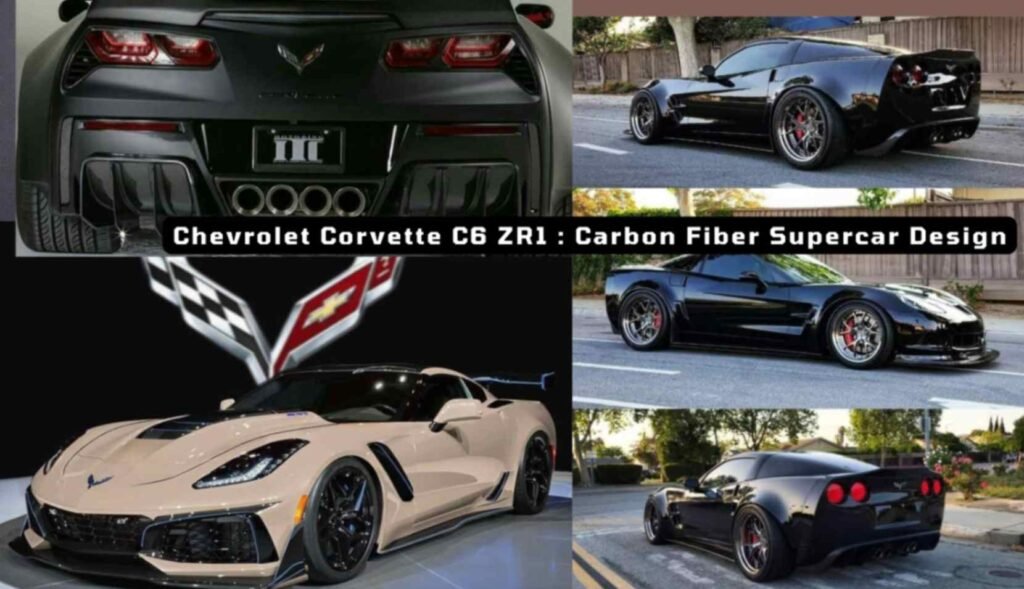
Chevrolet’s aim was to take on the enemy of weight with carbon fiber. Lightweight material is utilized on the roof, hood, front fenders, front splitter and rocker panels. The most popular design feature, however, is on the hood. Here’s a look at the supercharger cover of the LS9 engine, visible with a polycarbonate window. It’s a view that no other Corvette has ever provided.
There is also a larger body than a standard C6, with a flared body around huge Michelin Pilot Sport tyres – 285-section at front and 335-section at back. Completes the look with a raised hood, full-width rear spoiler and ZR1 badging. The car weighs some 3,350 lb, but that’s still not that heavy for its power output.
Braking, Suspension and Handling
The stopping power is provided by Brembo carbon-ceramic brake discs, a new feature on any Corvette and very unusual on a vehicle under $150,000 when the car debuted. These rotors have a fade lap after fade lap durability and will withstand heat which would cause destruction to normal steel brakes. Additionally, the ZR1 features Magnetic Selective Ride Control.
Here the dampers are filled with a magnetorheological fluid, and stiffness can be adjusted in milliseconds, so the car is comfortable on the road and sharp on the circuit.
Since 2010, Chevrolet has included launch control and five-mode Performance Traction Management, taken from the Corvette Racing program. Combined, these features allowed the ZR1’s massive power to be more easily accessed by normal car buyers.
Year-by-Year Changes (2009-2013)
2009
The launch year. The standard 1ZR could be chosen, or a better-equipped 3ZR (with leather, navigation and a Bose stereo). Initial prices were approximately $103,300.
2010
Chevrolet introduced launch control and Performance Traction Management and side airbags. The changes improved the car’s handling and performance and made it more manageable in daily driving.
2011
It was a year of mainly carryover options with a few changes, such as a new wheel finish and an optional museum delivery for the buyers.
2012
The largest mid-cycle change. It was the new PDE Performance Package, with Michelin Pilot Sport Cup ZP tyres, lighter wheels and new tuning of the suspension. This package was installed and the car set its fastest development lap times. 100 year of Chevrolet was celebrated with a Centennial Edition as well.
2013
The final year. The run was capped off with a 60th Anniversary package with Arctic White paint and Blue Diamond interior. C6 production concluded in February 2013 and the ZR1 name was left dormant until the ZR1 with 755 hp for the C7 came along in 2019.
Production Numbers and Rarity
During the five model years, only 4,684 C6 ZR1 were produced by Chevrolet. The best sales were in 2009, prior to the financial crisis and the car’s six-figure price hitting sales. Chevrolet produced tens of thousands of regular C6 Corvettes, by comparison. The ZR1 is therefore fairly rare, and low mileage ZR1s with the 3ZR trim level or the 2012-2013 Performance Package will be the rarest of all.
How much is one worth about C6 ZR1 Price Today?
Values have leveled out and are steadily climbing. The median price for a C6 ZR1 is about $90,000, according to aggregated market data. Higher mileage models are popular and have sold for $50,000 to $60,000, while pristine collectible models have been sold for $150,000 to $200,000, depending on the options. The model also keeps a healthy sell-through rate of 76% at its auctions, indicating strong and consistent demand.
Those are definitely recent auction numbers that are very strong. The price average for major U.S. auction sites such as Mecum, Barrett-Jackson and Bring a Trailer is typically found between $70,000 and $145,000 over the past two years. Special editions come with a hefty premium: A recent 2012 Centennial Edition recently sold for $140,000 at auction, and low-mileage 2013 models with the PDE Performance Package are regularly found at $160,000 to $180,000. In short, the C6 ZR1 is no longer a used car, but a certified modern collector’s car.
When purchasing a C6 ZR1, make sure to review the following:
The mechanical strength of a used ZR1 is comparable to that of a new one, but there are several points that smart buyers will check out.
First, verify the service history since the LS9 should be serviced with good oil and the supercharger drive system should be inspected regularly.
Second, thoroughly inspect the carbon-ceramic brakes. As the rotors are worn, they will make the cost of the replacement pretty expensive for the buyer, as the replacement rotors are extremely expensive.
Thirdly, check for the presence of modified cars, as those that have been modified tend to have less collector value and pose a greater risk of hard track use or tuning.
Documentation matters too. Clean accident history, two keys, signed engine plaque and original window stickers are all added value.
Lastly, choose the 3ZR and the 2012-2013 model years with the Performance Package as they are the most desirable, being the market leaders.
Corvette C6 ZR1 vs Nissan GT-R
The Nissan GT-R was the C6 ZR1’s biggest competitor from 2009 through 2013, and both vehicles are as unique as you can get. The turbocharged 3.8-liter twin-turbo V6 of the time was mated to a dual-clutch gearbox that delivered 480 to 545 hp to the all-wheel drive of the GT-R. The ZR1 responded with a manual transmission, front-wheel drive and 638 hp.
Both cars accelerated to 60 in about 3.3/3.4 seconds in a straight line, as the all-wheel drive launch of the GT-R balanced its lack of power. After that, however, the Corvette got away from her. It had a top speed of 205 mph which was easily higher than the GT-R’s 193 mph.
Even today, the driving experience is a split between buyers. The GT-R looks like a car that’s been built with the precision of a computer and manned by anyone who’d like to drive it quickly in all weather. The ZR1 requires skill, offers bravery and provides a raw supercharged V8 sound that Nissan just can’t duplicate.
According to Price at the time, the GT-R began at just under $80,000, whereas the ZR1 was up at more than $103,000.
But that has all shifted with the collector market. Nissan only produced R35 GT-Rs until August 2025, after a total of approximately 48,000 units, while Chevrolet produced only 4,684 C6 ZR1s. The rarity disparity is important.
Prices for early GT-Rs are still very affordable and available; clean ZR1s continue to rise at auctions.
If you’re looking to use it on a daily basis, the GT-R wins. If you’re looking for rare, sound, driver involvement, and value, there’s no contest, the C6 ZR1 is king.
C6 ZR1 vs C7 ZR1 – Which One is Better?
The C7 ZR1 was the last of the front-engine Corvettes and for all intents and purposes, it outshines them. The LT5 is a supercharged 6.2L V8 engine that generates 755 hp and 715 lb-ft of torque, can get to 60 in less than 3 seconds and can accelerate to a maximum of 212 mph. It was also available with the 8-speed automatic and the 7-speed manual, as well as new aero packages and electronics that the C6 lacked. The C6 is even rarer than the Chevrolet as only 2,953 of them were produced for that one model year.
The question is, why do many fans still prefer the C6 ZR1?
Character and purity.
The C6 ZR1 is only available in a manual transmission, weighs less and is more of an analog, connected sort of vehicle. It has a hand-signed LS9 engine and is built around the beloved hood window, providing it with a story that the C7 ZR1 doesn’t have.
Price matters too.
A C6 ZR1 will normally be less expensive than a C7 ZR1, which is currently selling for well over the $120,000 original sticker price.
The truth of the matter: the C7 is the performance car, while the C6 is the classic for the drivers.
Those who are looking for “numbers” can go for the C7. The C6 is the model for prospective purchasers looking for involvement and value.
Conclusion
The C6 ZR1 is a milestone in the performance history of American cars. It proved that Chevrolet could make a car that will run 200 mph using exotic materials and world-class braking, with the added benefit of being fully capable of running on the track, and for a mere fraction of the money it would cost in Europe to make a supercar.
The car is the cornerstone upon which every supercharged Corvette since it was built upon is founded, from the C7 Z06 to today’s model. A hand signed engine in each is added to the fact that only 4,684 were made, and the C6 ZR1 has proven itself to be a great classic for the future.
For those who appreciate the raw, manual-gearbox power that American automakers bring with the real rarity in tow, not many have a more compelling case.
FAQs
The C6 ZR1’s supercharged 6.2-liter LS9 V8 engine delivers 638 horsepower and 604 lb-ft of torque at 6,500 rpm and 3,800 rpm, respectively. It was the most potent production car GM has ever launched.
The verified top speed of the C6 ZR1 is 205 mph, the first production Corvette to go 200 mph. It can accelerate to 60 mph in approximately 3.4 seconds.
Generating a total production run of 4,684 C6 ZR1s from 2009 to 2013, the C6 ZR1 is one of the less-produced of the modern Corvettes.
The middle range price is just about $90,000. The actual auction results range from $70,000 for a high-mileage driver to up to $160,000+ for a pristine, low mileage car with the 3ZR trim and the 2012-2013 PDE Performance Package.
Values have ceased falling and are now heading upward for 2012-2013 Performance Package models, low mileage cars and 3ZR models. Limited in production and auction results are on the rise, it is like a modern collectible.