The suburban streets tend not to be predictable for too long. One week sees dry pavement with clear lines of sight. The following week is marked by slippery roads due to rain, leaves accumulated around the curbs, and loose asphalt where the city authorities haven’t finished resurfacing. Throw into the equation some unexpected potholes, hills during one’s trip back home from shopping, and patches of loose sand in driveways, and even an ordinary bike will quickly start seeming unreliable. Even the front wheel may slip upon hitting wet leaves at a bad angle.
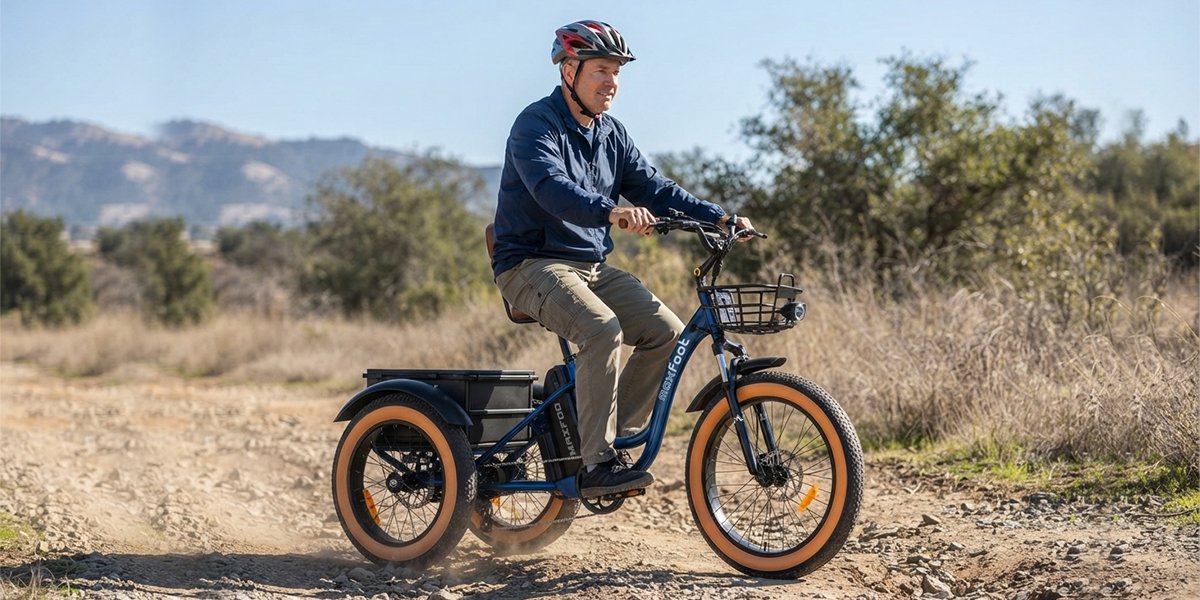
Here comes in the use of a tough, rugged electric trike for adults that brings about the difference. More ground contact, a tougher frame, and a torque-oriented motor make rough roads not a nightmare but an easy challenge to overcome. This article examines how the design and engineering of a good adult electric trike, using the MaxFoot MF-30 Electric Tricycle For Adults as a practical example, copes with rough terrain, hills, and rainy weather braking.
Why Two Wheels struggle where three wheels don’t
The regular bicycle relies completely on the balance of the person riding it, as well as the friction between two small areas of contact. This is not a problem when the road is dry and clear. However, on wet leaves, sand, or worn out road lines, a bicycle tire has almost nothing to hold onto, and a slide can happen in a fraction of a second.
The 3 wheel electric trike for adults fixes the problem of the vulnerable point of failure. The trike is equipped with three wheels and thus three points of contact with the road as opposed to the two of a bicycle. This makes it difficult for the trike to have a sideways movement that could otherwise lead to the rider falling. This means that the trike remains firmly on the road allowing the rider to concentrate on navigation instead of survival.
The fact that riders who have switched from standard bicycles to electric trikes adults is becoming more and more common every year tends to bring up balance as the first factor they notice. Balance is no longer an everyday concern. Mounting and dismounting also gets easier due to the step-through design used in most trikes, such as MF-30.
Potholes, Gravel and Cracked Road Surface
Harsh roads take a toll on your hands and shoulders way before you actually end up in an accident. Potholes send shock waves through your handle bars and soon enough you will start losing your grip on them.
The front suspension helps to absorb this shock prior to its reaching the handlebars. In the case of the MF-30, the front suspension helps to absorb the vibrations caused by rough road surfaces such as gravel and cracked asphalt. Stability is very important and is even more important than most new cyclists think. The two-wheeled bikes are particularly at risk of fishtailing when encountering loose gravel because there is almost no traction for the tire.
Wide tires give an extra level of safety on difficult surfaces. A fat tire electric trike for adults will distribute the weight on a larger surface area, which will increase the stability on such terrains as sand, gravel, and even on the rough curb cuts typical for old neighborhoods. A wide tire will also reduce the tire pressure to provide a comfortable ride on minor road bumps.
Some notable benefits of rough terrain:
- Front suspension decreases hand and shoulder fatigue during long rides
- Three ground contact points prevent slipping on wet or loose surfaces
- Wider Fat tires increase traction in sand, gravel, and uneven curb cuts
- A step-through frame ensures easy mounting and dismounting, even with a full basket
Climbing Hills Without Losing Traction
The quality of neighborhood hills quickly distinguishes between a well-made electric trike and a poorly made one. Motors that lack sufficient power will stop working half way through a hill and even spin the back wheel without moving forward.
The MF-30 uses a 750W motor, producing a peak of 1400W with 85Nm torque. It is important to understand that torque is the actual number that is responsible for the climbing ability of an electric bicycle. The torque is what causes the wheels to start moving when they have some weight on them and 85Nm is sufficient for lifting a rider and some cargo uphill without making the engine suffer or making the rear wheel spin. Going up a two-block hill to a bus station will be as easy as riding a regular bicycle.
Climbing power becomes insignificant without proper wheel grip when turning through the corner. Here comes into play a rear differential system in adult electric trikes built for hill climbing rather than flat neighborhood loops. Without having two rear wheels spinning with a fixed speed, a rear differential allows the wheels to have their own speed. In the case of a turn, the outside wheel will turn faster than the inside wheel, and this will provide tire grip on the road instead of one wheel dragging or losing traction.
The strength of the frame holds everything together. The MF-30 features a front frame made of 6061 aluminum alloy and a rear frame made of 7A19 aluminum alloy. It is built to transport 350 lbs of load on uneven pavements without bending or moving side to side while loaded. For those people who want to use their trike to transport groceries, pick up their grandchildren from school, or make short deliveries within the area, this is the most important figure for daily use.
When choosing between the fat tire electric trikes for adults currently available on the market, here are several distinguishing factors between a trike designed to do some serious work and one that simply looks tough in promotional pictures:
- Torque capacity of the motor, which is directly linked to the hill-climbing capability with load
- The presence or absence of a differential or a fixed shaft
- Type of material used to manufacture the frame along with the payload capability
- Width of the tires, which impacts their traction and comfort on rough surfaces
Safe Stopping When the Road Is Wet
The braking distance increases rapidly when the road is wet, and the fully loaded trike requires more power to stop than a regular bike. The rider who gets surprised and stops suddenly because of some other vehicle coming out of the driveway or someone crossing the road will have no time but rely upon the performance of brakes.
The dual rear disc brakes can manage this requirement much better than the single rear caliper brake. Disc brakes dry up quickly compared to rim brakes and provide reliable stopping power even after being used many times in the rain. A good example would be a rider who is braking at the pedestrian crossing or suddenly while driving in the traffic. The shorter distance covered by such riders prevents accidents from occurring. That’s why dual rear disc brakes are almost essential for a best electric trike for adults list.
Visibility is just as important as the braking capacity when the weather changes. Rain, fog, and early darkening all reduce visibility, making it difficult for the motorists to see the cyclist on the road. An integrated system that incorporates a headlight, brake light, and turn signals will solve this issue in the same way it is done in the case of cars, allowing drivers behind and adjacent to the trike to know what to expect. Commuters who cycle all year round or those who go shopping after work would particularly benefit from this system.
Battery safety is the last piece of the puzzle, even though it rarely receives as much consideration as brakes or headlights. The MF-30 uses a Samsung 20 Ah battery with UL-2271 certification, the battery safety requirement that is designed to minimize fire hazards in e-bike or e-trike batteries. This battery is certified safe, and along with the sealed construction, ensures that the battery survives exposure to weather and numerous charge cycles without any safety risks.
Wet weather safety features to look for in any model:
- Dual rear disc brakes for better stopping power
- Headlight, brake light, and signal lights combined for low visibility condition
- UL-2271 certified battery, meaning it is fire safety approved
- Sealed battery box, protecting it from water in rain or snow
The Difference Between a Good and a Bad Trike
Neither weather nor the condition of the roads often give you the luxury of waiting until they have cleared up to ride. The deciding factor here is whether your trike can deal with them or not. With a chassis capable of handling 350 lbs, a motor that provides 85Nm of torque, a rear differential, and dual disc brakes, riding through rain or taking a shortcut through gravel becomes a normal part of the week.
In case of senior citizens with stiff joints, commuters riding through unpredictable weather conditions, or anyone purchasing one of the current adult electric trikes, it is the specifications that really count, not the marketing speak that comes along with it. The four specifications that will actually define the performance of the trike on challenging days are frame composition, motor torque, braking system, and battery certification.