Buying a used car in the UK can save you thousands, but only if you check the right things before you pay. A car can look spotless and drive well on a short test drive while hiding outstanding finance, an insurance write-off, or a wound-back odometer.
The Quick Answer
Before buying a used car in the UK, check five things: the vehicle’s history, its MOT record, the V5C logbook and VIN, its physical and mechanical condition, and whether the price matches the market. A used car history check UK buyers can run with just the registration number covers most of the paperwork risks before you even view the car. The physical inspection and test drive then cover the rest.
This guide walks through each check in the order you should do them, so you can spot problems early and walk away before money changes hands.
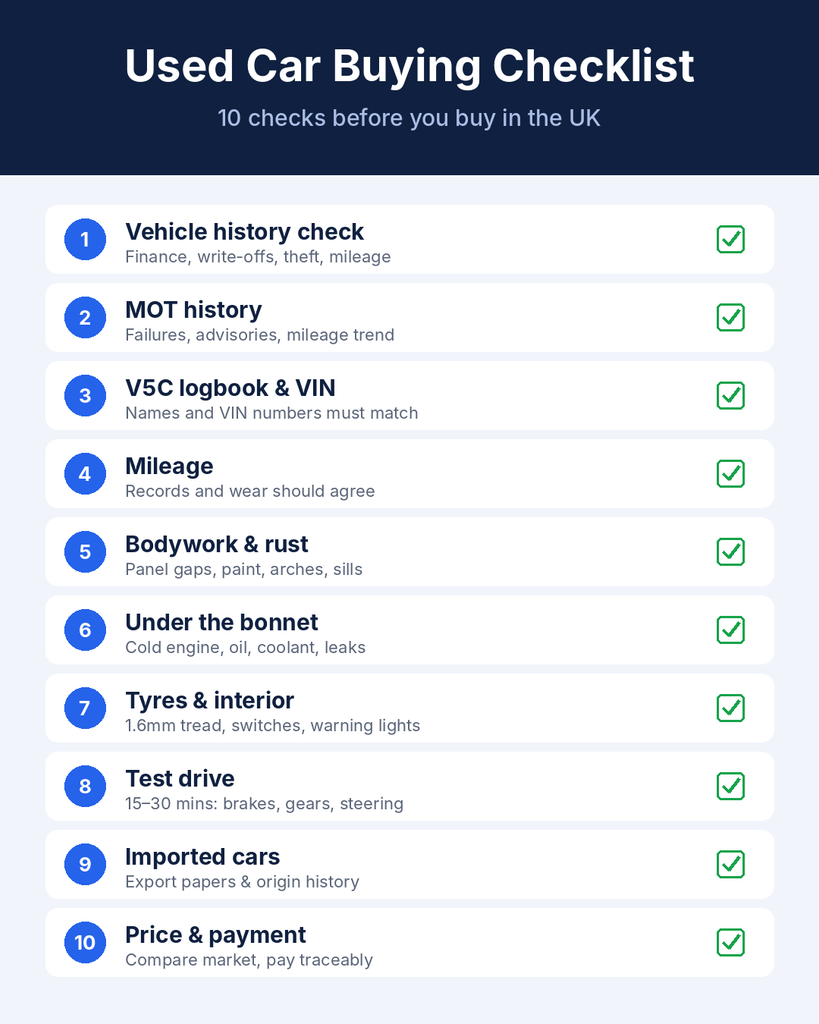
1. Run a Used Car History Check UK Buyers Can Trust
Start here, before you travel to see the car. A vehicle history check uses the registration number (and ideally the VIN) to search national databases for problems the seller may not mention.
A good history check should tell you whether the car:
- Has outstanding finance, such as a hire purchase or PCP agreement
- Has been recorded as an insurance write-off (Category A, B, S or N)
- Is reported as stolen
- Has mileage discrepancies across its recorded readings
- Has had number plate changes or a high number of previous keepers
- Has a colour or engine size that doesn’t match its records
Outstanding finance is the biggest risk. If a finance company still has a legal interest in the car, it may be able to reclaim it from you, even after you’ve paid. Services such as CarTrust bring these records together into one report, so you can see the full picture in a few minutes.
2. Check the MOT History
Any car in Great Britain over three years old needs a yearly MOT, and every test is recorded. You can check MOT history for free on GOV.UK using the registration number.
Look for:
- Repeated failures on the same item, such as brakes or suspension
- Advisories that keep appearing, especially corrosion warnings
- Mileage at each test, which should rise steadily, never drop
- Long gaps where the car wasn’t tested, which may mean it was off the road or unregistered
Advisories are not failures, but they tell you what will likely need money spent on it soon.
3. Inspect the V5C Logbook and Match the VIN
The V5C (logbook) shows the registered keeper, not necessarily the legal owner, but it is still a key document.
- Check it has a DVLA watermark when held up to the light
- Make sure the seller’s name and address match the V5C and their ID
- View the car at the address on the V5C, not in a car park or lay-by
- Match the VIN on the V5C to the VIN on the windscreen, the door pillar and the chassis plate
A mismatch between any of these is a reason to walk away.
4. Verify the Mileage
Low mileage only adds value if it’s genuine. Compare the odometer reading against MOT records, service stamps and old invoices. Readings should only go up over time.
Also check that physical wear matches the claimed miles. A shiny, worn steering wheel, smooth pedal rubbers or a sagging driver’s seat on a “low-mileage” car suggests clocking.
5. Look for Accident Damage and Rust
Inspect the car in daylight and dry weather, since rain and dim light hide paint flaws.
- Uneven panel gaps around doors, bonnet and boot
- Paint shades that differ slightly between panels
- Overspray on rubber seals, trim or glass
- Rust on wheel arches, sills, door bottoms and the underside
- Damp carpets or water in the spare wheel well, which can signal leaks or flood damage
If the history check shows a write-off record, ask for evidence of how and where it was repaired.
6. Check Under the Bonnet
Ask the seller not to start the car before you arrive. A warm engine can hide starting problems and noises.
- Oil: Check the level and colour. A creamy, mayonnaise-like residue under the filler cap can point to head gasket failure.
- Coolant: It should be clean and at the right level, with no oil floating in it.
- Leaks: Look for wet patches, fresh drips under the car, and grime around hoses and gaskets.
- Belts and battery: Check for cracked belts and corroded battery terminals.
7. Test the Tyres, Interior and Warning Lights
UK law requires at least 1.6mm of tread across the central three-quarters of each tyre. Uneven wear on the inner or outer edge suggests alignment or suspension problems. Check the DOT date code too, as tyres around six years old or more are often due for replacement.
Inside, test every switch: windows, locks, lights, wipers, air conditioning, heater and infotainment. When you turn the ignition on, the warning lights (engine, ABS, airbag) should come on briefly and then go out after starting. A light that never comes on may have been disabled to hide a fault.
8. Take a Proper Test Drive
Drive for at least 15 to 30 minutes on a mix of roads, including faster ones if possible.
- Listen for knocks or rattles on a cold start
- Check the car tracks straight and doesn’t pull to one side
- Brakes should stop firmly without vibration, grinding or pulling
- Gear changes should be smooth, with no slipping or crunching
- Watch the exhaust: blue smoke means burning oil, thick white smoke can mean coolant, black smoke means it’s running rich
- Listen for clunks over bumps, which point to worn suspension
9. Take Extra Care With Imported Cars
Japanese and other imported cars are popular in the UK, but their history before arriving here often isn’t held in UK databases. An imported car history check fills that gap by looking at records from the country of origin, such as Japanese auction data and export mileage.
For any import, ask for the export certificate and import paperwork, and check that the mileage recorded at export matches what you see now.
10. Compare the Price and Pay Safely
Compare the asking price with similar cars of the same make, model, year, mileage and condition. A price far below market value usually means there’s a problem the seller hasn’t mentioned.
Before you pay:
- Get an independent pre-purchase inspection from a mechanic you choose, not the seller’s
- Use any faults you found to negotiate the price
- Pay by bank transfer rather than large amounts of cash, so there’s a record
- Get a written receipt with the VIN, registration, price, date and both parties’ details
- Make sure the V5C is updated so the car is registered to you, and arrange tax and insurance before driving away
Buying from a dealer gives you more protection. Under the Consumer Rights Act 2015, you can usually reject a faulty car within 30 days. A private seller only has to sell the car “as described”, so your own checks matter even more.
Red Flags That Mean You Should Walk Away
- The seller won’t allow an independent inspection
- The VIN doesn’t match the V5C, or the seller’s details don’t match the logbook
- The history check shows outstanding finance with no proof it will be settled
- MOT mileage goes down at any point
- The price is far below similar cars
- The seller rushes you, wants cash only, or keeps changing the story about why they’re selling
- Signs of flood damage or poorly repaired structural damage
Frequently Asked Questions
What is the most important check when buying a used car in the UK?
A vehicle history check is the most important, because it reveals outstanding finance, write-offs and theft records that you can’t see by looking at the car. Do it before you view the car.
Is the GOV.UK MOT history check enough on its own?
No. The free MOT history shows test results, advisories and recorded mileage, but it doesn’t show outstanding finance, theft or write-off status. You need a full history check for those.
Can I check a car’s history with just the registration number?
Yes. Most UK history checks only need the registration number. Adding the VIN helps confirm the car is genuine and that its plates haven’t been swapped.
What happens if I buy a car with outstanding finance?
The finance company may still have a legal claim on the car, and you could lose it or face a long dispute. Always confirm the finance is settled before you pay.
Do I need a mechanic to inspect a used car?
It isn’t required, but it’s strongly recommended. An independent inspection can find hidden fault codes, frame damage and wear that most buyers would miss, and it costs far less than a major repair.
Final Checklist Before You Buy
- Run a full vehicle history check
- Check MOT history and mileage on GOV.UK
- Confirm there’s no outstanding finance
- Match the VIN to the V5C and the seller’s ID
- Inspect the bodywork, tyres and interior in daylight
- Check under the bonnet with the engine cold
- Test drive for at least 15 minutes
- Get an independent mechanic’s inspection
- Compare the price with similar cars
- Pay traceably and get a written receipt
Final Thoughts
A used car should never be bought on looks or price alone. Most expensive mistakes come from problems that a few minutes of checking would have caught.
The safest order is simple: run a used car history check UK databases can confirm, review the MOT record, inspect the car and its documents in person, then get an independent mechanic to look it over. If everything lines up, you can buy with confidence. If it doesn’t, walk away, because there’s always another car.