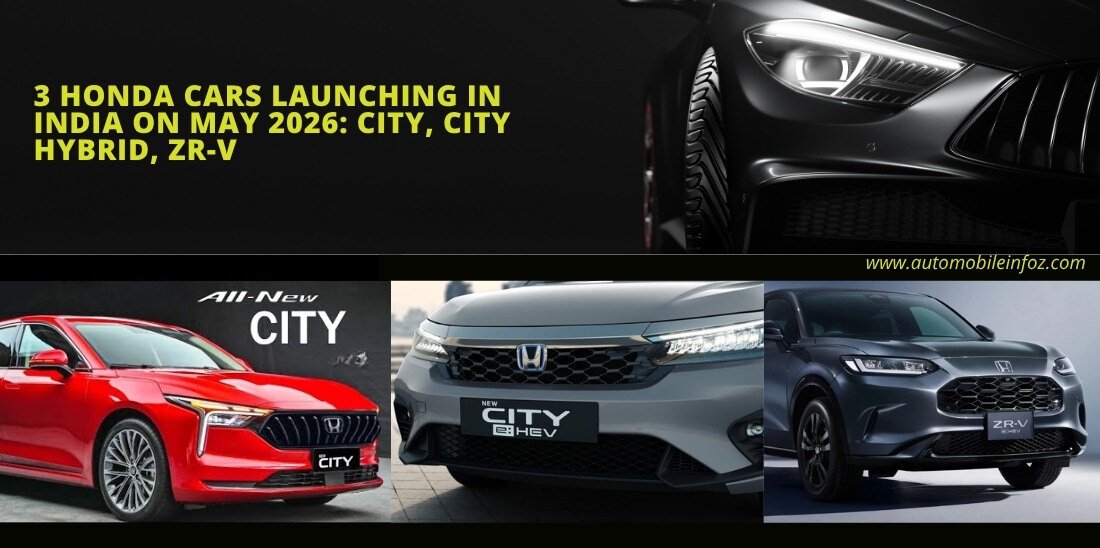
On May 22, 3 Honda Cars will be making their debut in India with the Honda City Facelift, Honda City Hybrid and Honda ZR-V.
Honda has always been good at drawing the attention of India. At the same event, Honda Cars India will launch three groundbreaking models – the refreshed Honda City, Honda City e:HEV hybrid and the all-new Honda ZR-V. The triple launch is a sign of renewed strength from the Japanese automaker in one of the world’s most competitive auto markets.
This is indeed exciting for Indian Car Buyers. For more than 20 years, the Honda City has been an iconic sedan. The ZR-V, on the other hand, is the boldest premium SUV offering by Honda in India so far. These three cars target various customer segments and personalities — and all three make their debut on the same day.
For Honda India, 22nd May holds special significance
For Honda India, May 22 is a memorable date. Honda Cars India has been having rough times. During the same period in April 2026, the company sold 4069 units in the domestic market, which was not a lot when compared with the segment’s sales. The City has been steadily losing ground to some rivals – the Hyundai Verna, Volkswagen Virtus and Skoda Slavia – as they have been making additions and changes to their ranges.
May 22, 2026 is actually not just simply regular product scheduling. It’s an intentional, strategic message. With the City being updated in tandem with the City and the introduction of the aspirational ZR-V, Honda is going for both the volume buyer in the midsize sedan market and the premium SUV buyer in one shot. This launch is being closely monitored by the automotive industry as such.
Honda City Facelift 2026 – A familiar favourite but, freshened up
The 2026 Honda City is the second mid-cycle refresh of the 5th generation model, which has been first launched in India in 2020 and has been refreshed for the first time in 2023. The facelift will help maintain the car’s competitiveness in the market until the next generation of the vehicle is expected to arrive around 2028.
In terms of design, the changes are not likely to be significant. According to sources, the front grille is being reshaped with a slatted pattern, the headlamps using LED technology have been redone and the front and rear bumpers are also getting a makeover. Side profile will be mostly the same, with new designs for the alloy wheels and some new colour variants providing some variety.
The more important changes are likely to be on the inside of the cab. The present City is beginning to feel a bit underwhelmed at the features end. To bridge that divide, the facelift should not only have a larger 10.25-inch touchscreen infotainment system (up from the current 8-inch screen) but also ventilated front seats, a powered driver seat and a 360-degree parking camera. The same lineup of wireless Android Auto, Apple CarPlay, climate control and Honda Sensing Level 2 advanced driver assistance features are expected to remain the same.
Powertrain-wise, Honda is not likely to make any mechanical changes. The naturally aspirated 1.2-litre petrol engine that makes about 121 PS and 145 Nm is also being carried over, whichever gearbox is selected, a 6-speed manual or CVT automatic. This is a well proven engine which has gained a good reputation in India and Honda need have no reason to ‘patch up’ what is not broken.
The new City will be priced accordingly to the increased equipment. The facelift is currently on offer for Rs 12 lakh to Rs 16.07 lakh (ex-showroom), and could go up by Rs 50,000 to Rs 75,000 depending on the variant, keeping it competitive against the Verna, Virtus and Slavia.
Honda City e:HEV Facelift 2026 — Hybrid Efficiency, Refreshed
The Honda City e:HEV strong hybrid is a game-changer in the sedan segment, and one of the few strong hybrid sedans in this price range. The facelift makes it look just as fresh as the newly updated standard City – no major exterior design changes.
From a mechanical point of view, the City e:HEV will retain its 1.5 litre petrol-based hybrid configuration and have a torque of 253 Nm at 2,500 rpm and a power of 124 bhp, alongside an e-CVT gearbox. Its real power is its fuel efficiency, one of the best in the midsize sedan segment in India. Real-world efficiency ratings have always been impressive and is this the car’s best selling feature.
City e:HEV enhancements will follow the same pattern as the standard City with larger touch screen, ventilated seats, powered driver’s seat and 360 degrees camera. The hybrid variant is priced at Rs 20 lakh (ex-showroom) and is likely to get a slight hike in price too. The City e:HEV is definitely one of the most promising options in the midsize sedan segment for those who value more practicality and refinement than outright performance.
Honda ZR-V – All-New Premium SUV Entry is the Honda ZR-V
The main attraction of the May 22 event is the Honda ZR-V. The ZR-V is a CBU (Completely Built-Up) unit, and will be imported straight to the Indian market and not made locally. This can help it immediately get priced in the premium range, with estimates ranging between Rs 40 lakh to Rs 50 lakh (ex-showroom).
In appearance the ZR-V is a sporty crossover model that is more distinctively different than the more upright Honda Elevate. It is set on an athletic, rounded stance with an attention grabbing front fascia. Measuring a corking 4,568 mm long, 1,840 mm wide and 1,620 mm high, with a wheelbase of 2,657 mm, the one that dimensions offers pretty good road presence, and a proper five-seater SUV.
ZR-V’s cabin technology is quite impressive, no matter by what measure! The international spec includes a 9-inch touchscreen infotainment system, a 10.25-inch fully digital instrument cluster, a 12-speaker Bose audio system, dual-zone automatic climate control, ambient lighting, a head-up display, powered front seats, powered tailgate and a panoramic sunroof. A complete safety suite includes 11 airbags, Level 2 ADAS (Advanced Driver Assistance Systems), front and rear parking sensors and TPMS (Tire Pressure Monitoring System). Not all of these features will carry over to the Indian-spec car, though.
The ZR-V’s mechanical transmission is a 2.0-litre naturally aspirated petrol engine with powerful two-motor hybrid technology. It has a total delivery of around 182 bhp and 315 Nm of power, coupled with an e-CVT gearbox. Positioning the ZR-V in its segment and range is against the Skoda Kodiaq and Volkswagen Tiguan, but in comparison with its top price tag, the ZR-V could compete with the Toyota Fortuner.
The ZR-V is Honda India’s dual purpose model. In the commercial realm, it extends the brand’s presence into the premium SUV market. Tactically, it serves as a halo product, boosting the perception of the brand and showcasing Honda’s hybrid technology credentials in a market where electrification is gaining traction.
The Impact of a Triple Launch for Indian Buyers
The May 22 launch event offers Indian buyers three very different propositions, overall. The standard City facelift will be a reliable, feature-rich sedan at a reasonable price. The City e:HEV facelift is aimed at those who are looking to buy something efficient, but want the benefits of a sedan, with much reduced operating costs. The ZR-V, on the other hand, is targeted to those who seek the top in positioning, performance and technology in an SUV format.
Honda is not only reaching out to the three buyer segments in one package, but it’s doing so in a way that will give the maximum amount of media attention and showroom traffic. Also, the launch of the City and City Hybrid together guarantees that people who are interested in buying either variant are getting the newer versions instead of going for an old model and a new model.
The midsize sedan segment is getting hot in 2026, as the Hyundai Verna is already getting a facelift and the Volkswagen Virtus and Skoda Slavia are also scheduled for a facelift. So Honda is playing its cards right and the new City should come to market before the market is even more competitive.
Conclusion
May 22, 2026 promises to be one of Honda India’s biggest one-day events in years. The City and City e:HEV facelift will recapture a familiar identity and the Honda ZR-V will put the Honda brand on the map in the luxury hybrid SUV segment. These three cars together speak at Honda’s strategic thinking level, not merely of the sale and market performance of the moment but regarding where the brand wants to be in the Indian market in the next three to four years.
For those looking for a sophisticated sedan or a high-end hybrid SUV, May 22 is a date to keep in mind.
FAQs
On May 22, 2026, Honda is launching 2026 Honda City facelift, 2026 Honda City e:HEV hybrid facelift and all-new Honda ZR-V in India.
The Honda ZR-V will be priced between Rs 40 lakh and Rs 50 lakh (ex-showroom prices) as the car will be imported as a CBU (Completely Built-Up) unit.
The Honda City 2026 is likely to receive a larger 10.25-inch touchscreen, ventilated front seats, a powered driver’s seat, and a 360-degree camera, as well as styling tweaks to the grille, headlamps and bumpers.
Changes to the engine are not anticipated. The City facelift will continue to be powered by the current 1.5-litre naturally aspirated petrol engine (121 PS / 145 Nm) mated to a 6-speed manual or CVT transmission, while the hybrid version will keep the 1.5-litre e:HEV combination with 124 bhp.
The Honda ZR-V will square up to the Skoda Kodiaq and Volkswagen Tiguan in its classy mid-size SUV segment. If the price is higher, it can also be compared to the Toyota Fortuner.
Also, Read About –
Toyota’s 5 Upcoming Cars for India in 2026: Prices, Features and Launch Dates