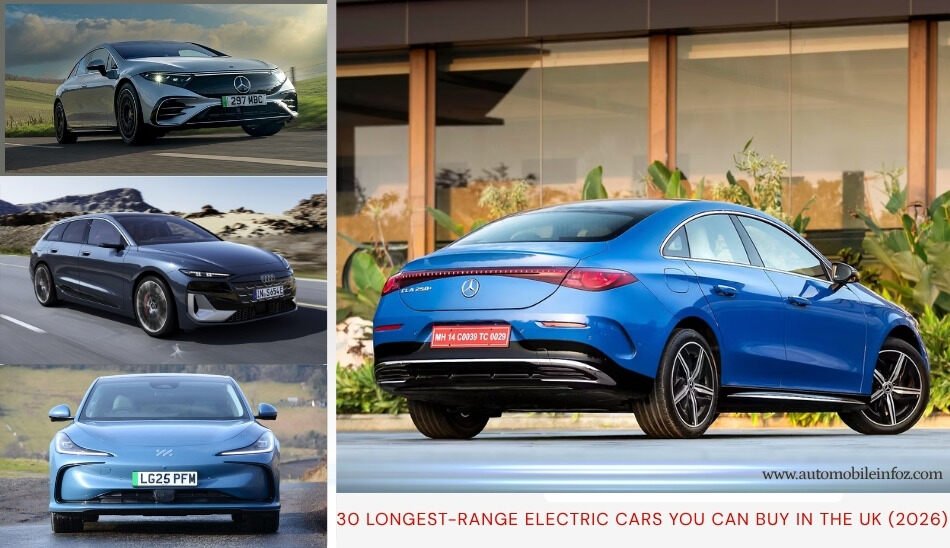
After the so-called Range Anxiety Era, the UK is finally over it — here’s the proof
Half the country was once deterred from the purchase of an electric car by the term range anxiety. Not any more. The longest range electric cars that are on sale in the UK right now reach from a decent 383 miles up to the truly amazing 575 miles of range. It should be enough for London to Edinburgh and back. And manufacturers are just beginning to do what they can.
Charging, cell chemistry and aerodynamics are all quickening up, and 2026 has given us one of the most impressive lists of long range EVs the UK has ever seen. Here’s the definitive list of the longest-range electric cars available in the UK today.
Why Range Still Matters, Even with Better Charging Infrastructure
Over the last two years, we have seen a huge improvement in public charging in the UK. Charging points are now being rolled out at an increasing speed on the motorway service areas, in the 150kW, 350kW and even 400kW speed range. For all the improvements, one of the big three criteria remains for British EV buyers and it makes sense! No one is always close to a motorway corridor.
A bigger battery and longer real-world range means better direct benefits for rural drivers, long-distance commuters and those who don’t have access to home charging. Furthermore, the 500 mile range is a theoretical range, and for most users will require only two or three top-ups from empty a year, whereas a 250 mile pack range would require nearly ten times more.
Also, the higher models are usually larger, with less cycle life than the lower. An 80kWh battery being charged to 80 per cent takes less stress off the battery than an 80kWh battery being run close to zero each day. This smoother cycling over time can lead to improved long term battery health. So, the longer range EV is often a better long-term investment option than it is a number to display at the school gate.
What do WLTP Range Figures Mean?
All range figures below are based on the WLTP (Worldwide Harmonised Light Vehicle Test Procedure) test cycle that superseded the earlier NEDC cycle in 2018. WLTP testing is based on a wider range of driving speeds, temperatures and accessory loads than its predecessor. But that is still a best case scenario. In the real world, the range is usually 15 to 25 per cent lower than the WLTP level due to varying factors such as driving speed, ambient temperature, heating or air-conditioning use and tyre pressure.
For a practical purpose, you can expect to get about 75-85% of the quoted WLTP number on a typical journey when driving on a motorway. However, in stop-start traffic, many car drivers actually surpass WLTP predictions because of the low speed of town driving. In addition, the range of the UK’s winter temperatures can also lower range by up to 30 per cent when compared with mild weather testing conditions.
Therefore, the buyer should use WLTP data as a reference point for comparison, but not as a representation of what will actually happen in their daily driving, and should take weather conditions into account when buying the battery size.
The Full List: 30 Longest-Range Electric Cars Available in the UK (2026)
All WLTP range estimates are manufacturer-provided, May 2026. Where published, battery capacities are for the usable capacity of the battery.
| Car | WLTP Range | Battery | Ket Detail |
| Mercedes EQS 450+ | 575 mi | 122 kWh | 800V / 350kW fast charge |
| BMW i3 50 xDrive | 562 mi | 108.7 kWh | 400kW fast charge capability |
| Volvo EX60 Twin Motor | 503 mi | 117 kWh | 800V / 400kW, cell-to-body battery |
| BMW iX3 50 xDrive | 500 mi | 108.7 kWh | 400kW fast charge; 231 miles in 10 min |
| Mercedes-Benz CLA 250+ | 484 mi | 85 kWh | 800V / 350kW; 200 miles in 10 min |
| Mercedes-Benz C 400 4Matic | 473 mi | 94 kWh | 330kW; 202 miles in 10 min |
| Audi A6 e-tron Sportback Performance | 470 mi | 94.9kWh | 0.21Cd drag and RWD single motor |
| Tesla Model 3 Long Range RWD | 466 mi | N/A | Supercharger network access |
| DS No 8 Long Range | 466 mi | 97.2 kWh | 0.24Cd drag; FWD fastback |
| MG IM5 Long Range RWD | 441 mi | 100 kWh | 800V / 396kW; 17 min 10–80% |
| Polestar 3 Long Range | 438 mi | 111 kWh | Single motor; 295 bhp |
| Volkswagen ID.7 Pro S | 436 mi | 86 kWh | 0.23Cd drag coefficient. |
| Peugeot E-3008 Long Range | 435 mi | 97 kWh | FWD; Stellantis platform |
| Mercedes-Benz EQE 350+ | 429 mi | 96 kWh | Refreshed 2024; +49 miles vs old |
| Volvo ES90 Twin Motor | 426 mi | 106 kWh | AWD; 350kW / 22 min 10–80% |
| BMW iX xDrive60 | 426 mi | 109.1 kWh | Facelifetd -(light-up kidney grille). |
| Vauxhall Grandland Electric | 425 miles | 97 kWh | most frugal of trio, on the stellantis platform |
| Citroen e-C5 Aircross Long Range | 421 mi | 97 kWh | Stellantis platform; roomy cabin |
| Porsche Taycan (RWD) | 421 mi | 105 kWh | 320kW; 18 min 10–80% |
| Polestar 5 Long Range | 421 mi | 112 kWh | 800V; 22 min 10–80%; 737 bhp |
| Peugeot E-5008 | 414 mi | 97 kWh | 7 seats; FWD; Stellantis platform |
| Audi Q6 Sportback e-tron Performance | 410 mi | 94.9 kWh | RWD, sleek coupe-SUV shape |
| Polestar 2 Long Range | 408 mi | 82 kWh | Single motor; improved from 336 miles |
| Mercedes-Benz GLC 400 4Matic | 405 mi | 94 kWh | 330kW; 186 miles in 10 min |
| Porsche Cayenne Electric | 399 mi | 113kWh | twin motors, 408 bhp standard |
| Porsche Macan (RWD) | 398 mi | 100 kWh | 110 kg lighter than AWD; 355 bhp |
| Tesla Model Y Long Range AWD | 391 mi | N/A | Bestselling EV in the UK |
| Polestar 4 Long Range | 385 mi | 94 kWh | Aero gains, No rear window |
| Volvo EX90 Twin Motor | 383 mi | 107 kWh | 7 seats; Lidar roof sensor |
| Audi Q6 e-tron (standard SUV) | 395 mi | 94.9 kWh | Less aero than Sportback; AWD opt. |
Stand out Models worth your attention
The Mercedes EQS 450+ is on top of the pile, and now boasts a 575-mile WLTP range thanks to the huge battery, plus the sport’s most aerodynamic production car yet with a 0.20 drag coefficient. With 800-volt architecture, 200 miles of range can be topped up in 10 minutes with a compatible 350kW charger to make long motorway journeys truly stress-free. Be ready to deal with the polarising yoke-style steering wheel.
The BMW i3 follows closely in second place, and is a key moment for the brand. Not the saloon of the same name, this new 3 Series electric is a slippery pouch with a 0,21Cd drag which doubles the range of the usable battery to 108,7kWh (562 miles). The 400kW charging speed is one of the quickest of any vehicle currently on sale in the UK. The Volvo EX60 is just as impressive, with a 503 mile range powered by a groundbreaking cell-to-body battery design that incorporates cells within the structural frame, saving weight and increasing rigidity at the same time.
The Porsche Taycan’s 421-mile figure, after a major mid-life facelift that included a 105kWh gross battery and a maximum charging speed of 320kW, is astounding for anyone who’s looking for a true sports car in addition to the range stats. The Polestar 3 Long Range is also worth pointing out, the RS variant having an 111kWh pack for a single motor claiming 438 miles and the further performance tipped versions of the same car available for power users. In the meantime, the Mercedes CLA 250+ proves that adequate aerodynamics can get you a good amount of range with a modestly sized 85kWh battery, squeezing 484 miles out of it with a C02 of .21.
At the other end of the scale, the Peugeot E-3008 and the Vauxhall Grandland Electric are both built using the same battery platform from the Stellantis Group, and have ranges of 435 and 425 miles at significantly cheaper prices than their German-brand counterparts. Families with seven passengers will find the Peugeot E-5008 with its claimed 414 miles of range and true third row seating to be another rarity in the electric vehicle world.
What to Consider Beyond the Range Figure.
Range is just one factor in ownership. For drivers who do frequent long journeys, charging speed can also be crucial. An EV with a 500-mile range but a 50kW charge rate will have a much longer time to spend at a motorway service area than a 400-kilometer range EV with a 350kW charge rate. All four vehicles, the BMW iX3, the Volvo EX60, the MG IM5 and Mercedes EQS can be charged with 350kW or more, meaning that a substantial range can be gained within the time taken to grab a cup of coffee.
The design of the battery is also important. The reason for this is that 800-volt vehicles charge faster per battery volume, as more power can be transferred to the battery resulting in less heat generation.The reason is that 800-volt vehicles charge faster per battery volume as more power can be transferred to the battery with less heat generation. For those who are booking regular long-distance trips, it would be best to opt for a 800V compatible car as it will allow them the most hassle-free experience at UK rapid charging stations.
Lastly, think about how well the car will perform in the real world, compared with WLTP. The 575 mile result at ideal test conditions, could mean around 430 miles in a Jan motorway test. For most normal driving around the UK, however, even the cheapest car in this list has plenty of headroom to ensure you won’t have to worry about charging your car for your weekly shopping, school runs or commute.
FAQs
The Mercedes EQS 450+ is currently leading the pack with a WLTP range of 575 miles as of May 2026. It has a 122kWh battery, 0.20 drag coefficient and 800V architecture to give it the most range capable electric car available in the UK. The BMW i3 (which isn’t the old hatchback — the new electric 3 Series) is right on the heels of the i7 with 562 miles.
WLTP testing is more representative of real-world driving circumstances than NEDC testing, but is still under ideal conditions. The WLTP figure is a realistic representation of the fuel consumption of a car on the motorway, and in reality, UK drivers can expect to get between 75% and 85% of this figure. Of course, real-world range is further reduced with cold winter weather, high speed cruising and heavy accessory loading (such as heating). Highly dynamic driving conditions, such as in urban areas, can push actual consumption beyond WLTP results because of the use of regenerative braking.
Some of the models listed here come with charging speeds of 350kW or higher, and 800V architecture. Both the BMW iX3 and the BMW i3 can charge up to 400kW and can charge over 200 miles in 10 minutes. The Volvo EX60, the MG IM5 396kW and the Mercedes CLA 250+ and EQS both have 350kW rapid charging.
Peugeot’s E-5008 is one of the few fully electric SUVs to be available in the UK and boasts a WLTP range of 414 miles from a 97kWh battery that holds 7 seats. The other major variant, Twin Motor, adds 383 miles of range to the Volvo EX90’s seating capacity of seven.
The Peugeot E-3008 (435 miles), Vauxhall Grandland Electric (425 miles) and Citroen e-C5 Aircross Long Range (421 miles) are all powered by the 97kWh battery platform of the Stellantis Group and are all competitively priced. Another value option for those looking for a long-range saloon/estate is the Volkswagen ID.7 Pro S at 436 miles.
Also, Read About –
15 Upcoming Chinese Cars Expected To Launch In India In 2026