Vespa scooters are some of the most well-known 2-wheelers around the globe. They are recognized for their unmistakable Italian design, high-quality materials and a comfortable ride, and have been popular for almost 80 years. Vespa scooters, which have been around since 1946, are more than just a means of getting from point A to point B. They have turned into fashion, elegance as well as city mobility symbols. The timeless design and strong engineering have enabled the brand to continue to hold its own in worldwide markets in Europe, Asia, Australia and North America. The newer Vespa models are able to combine old fashioned design with newer technology.
This article will provide complete information about Vespa scooter.
Vespa Company Overview
Vespa has been established in Italy since 1946, and it is one of the most successful scooter brands to be developed. The company is owned by Piaggio Group, a leading and well respected two-wheeler manufacturer in Europe. Vespa was designed to be a low-cost alternative to conventional transportation in post-war Italy, but the design proved to be a hit and was adopted in many countries around the world. The brand gradually grew in scale, exporting to other countries and coming to represent Italian craftsmanship and sophistication.
Vespa’s monocoque steel body construction is one of the main differentiating features of the product compared to many of its competitors. Vespa’s pressed-steel chassis is not only the body, but also the chassis, in contrast to traditional scooters, which are mostly made of plastic over tubular frames. This building technique contributes to the scooter’s longevity and adds to its unique style. Vespa today is making many different variants of their bikes—from 50cc up to 310cc, and even electric. The brand is still dedicated to the quality, technology and design excellence and expanding its reach to global markets.
| Attribute | Corporate Information |
| Parent Organization | Piaggio & C. S.p.A. |
| Founding Year | 1946 |
| Origin | Italy |
| Headquarters | Pontedera, Tuscany, Italy |
| Manufacturing Facilities | Italy, Vietnam, India |
| Product Category | Premium Lifestyle Scooters |
| Engine Options | 50cc, 125cc, 150cc, 310cc and Electric |
| Global Presence | Europe, Asia, North America, Australia |
| Sales Network | Authorized Dealers and Motoplex Showrooms |
Vespa Scooter Price and Variants
Vespa scooters are positioned in the premium Scooter segment which implies they will typically be more costly than the primary market. They’re more expensive, but they come in a higher quality, with imported parts, cutting edge technology, top paint finishes and a high heritage value. The price disparity between countries is due to a number of factors, such as taxes, registration fees, insurance and import taxes.
Vespa is mainly targeting the 125cc and 150cc segments in India, with the bigger models (GTS 310 and electric versions) sold internationally. Purchasing customers should also note that final on-road prices can vary by state taxes, insurance packages and dealership fees. Even though Vespa scooters are more expensive, they can have a great resale value and therefore offer a good long-term investment.
| Base Model Class | Variant Trim Level | Estimated Ex-Showroom Price | Estimated Average On-Road Price |
| Vespa 50 Series | Primavera 50 / Sprint 50 | $4,100 – $4,300 | $4,600 – $4,950 |
| Vespa 125 Series | ZX 125 / VXL / SXL | ₹1.14 Lakh – ₹1.35 Lakh | ₹1.34 Lakh – ₹1.62 Lakh |
| Vespa 150 Series | Primavera 150 / Sprint S | $5,400 – $5,800 | $6,100 – $6,650 |
| Vespa Tech 150 | SXL Tech / VXL Tech | ₹1.45 Lakh – ₹1.55 Lakh | ₹1.72 Lakh – ₹1.86 Lakh |
| Vespa GTS 310 | GTS Super / SuperTech | $7,999 – $8,699 | $9,100 – $10,050 |
| Vespa Elettrica | Primavera Elettrica | $7,200 – $7,900 | $7,600 – $8,400 |
Vespa Scooter Top Speed, Engine & Performance
Vespa’s various engine choices are available for various riding styles. The entry-level 50cc scooters are designed for city navigation and convenience, whereas models with higher cc ratings, such as 125cc and 150cc, offer better acceleration and highway performance. The flagship GTS 310 models offer an amazing touring performance and can be used for long distances and top speeds.
Fuel economy, emissions reduction and quietness are Piaggio’s current engine technologies. Advanced fuel injection systems provide stable performance in different temperature and riding conditions. The bigger HPE engines used in GTS models offer more power for acceleration and are very reliable and refined.
| Model Family | Engine | Power | Torque | Top Speed |
| Vespa 50 | 49cc Air-Cooled | 3.2 HP | 3.0 Nm | 45 km/h |
| Vespa 125 | 124.5cc Fuel Injected | 9.4 HP | 10.1 Nm | 90 km/h |
| Vespa 150 | 154.8cc Fuel Injected | 12.3 HP | 12.4 Nm | 98 km/h |
| Vespa GTS 310 | 310cc Liquid-Cooled HPE | 25 HP | 28.9 Nm | 129 km/h |
| Vespa Elettrica | Electric Motor | 5.3 HP | 200 Nm Wheel Torque | 70 km/h |
Vespa scooter Mileage & Fuel Economy
One of the major benefits of owning a Vespa scooter is its fuel efficiency. The high-tech i-get engine technology from the brand ensures optimum fuel consumption by using precise fuel injection and intelligent engine management systems. This way riders can save on their operating cost and have great performance.
The Vespa Elettrica is a completely different riding experience with its electric power. It has a negligible tailpipe emission and it has a low cost of charging, making it an environmentally friendly choice for urban mobility. Its low running costs can be very advantageous for riders who are going short distances every day.
| Model | Fuel Tank | Claimed Mileage | Estimated Range |
| Vespa 50 | 8 Litres | 40 km/l | 300 km |
| Vespa 125 | 7.4 Litres | 45 km/l | 310 km |
| Vespa 150 | 7.4 Litres | 42 km/l | 290 km |
| Vespa GTS 310 | 8.5 Litres | 31 km/l | 245 km |
| Vespa Elettrica | 4.2 kWh Battery | 100 km Range | 70-100 km |
Off-Road Hardware & Capability
Vespa scooters are designed for the main use on paved and urban roads! Their suspension systems, wheel sizes, and the variety of tyres are geared toward city riding, not off-road adventures. This means that they thrive on smooth roads, highways and urban streets.
Some rough surfaces may be negotiated carefully but riders should be prepared to avoid challenging off-road surfaces. Dirt trails, rocky paths or deep mud are not a good choice of terrain for these scooters due to the small wheel size and lack of ground clearance.
| Feature | Specification |
| Ground Clearance | 130–155 mm |
| Wheel Size | 10–12 Inches |
| Tire Type | Street-Focused Tubeless Tires |
| Frame Construction | Steel Monocoque |
| Off-Road Capability | Limited |
Vespa Scooter Features
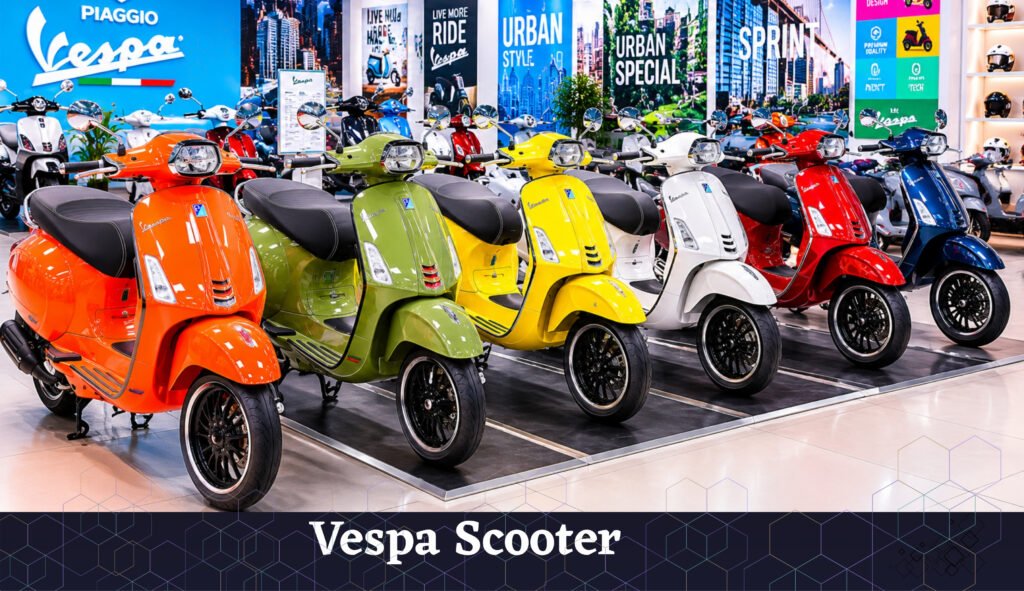
It would be easy to mistake the many modern Vespa scooters for their classic designs, but they have quite a bit more technology than they look. The more expensive models are equipped with smartphone connectivity, color TFT screens, navigation, Bluetooth, keyless ignition and USB charging ports.
These features add to the convenience yet retain the Vespa’s traditional styling. While staying true to the timeless design of scooters, riders can enjoy the convenience of navigation, phone calls and tracking vehicle performance.
| Feature | Description |
| TFT Display | Full-Color Digital Instrument Cluster |
| Vespa MIA | Smartphone Connectivity System |
| Keyless Start | Available on Premium Models |
| USB Charging | Standard on Select Variants |
| Storage Space | Underseat Helmet Storage |
| LED Lighting | Full LED Headlamp and Taillamp |
Vespa scooter Exterior Design Highlights
One of Vespa scooters’ most notable features is its unique look. Each model is still built with the iconic steel body design that has been a hallmark of the brand for decades. Smooth curves, elegant proportions, and high quality paint finishes provide a timeless appeal which sets itself apart from standard scooters.
Newer models also feature high-tech LED lights, chrome accents, alloy wheels and quality finishes, for a more attractive look. These features play a big role in the Vespa positioning in the world’s markets.
Vespa Scooter Safety Features
There have been significant enhancements in safety technology on the Vespa family. Newly developed systems are anti-lock brakes, combined brakes, traction control systems and electronic immobilizers. These are beneficial to make the rider more confident and keep them stable in emergencies.
The safety equipment is the most up-to-date in the premium GTS models, with traction control systems that help to control wheel slip during acceleration on slippery surfaces.
| Safety Feature | Function |
| ABS | Prevents Wheel Locking |
| CBS | Balanced Braking Performance |
| ASR Traction Control | Reduces Rear Wheel Slip |
| Engine Immobilizer | Theft Protection |
| LED Lighting | Improved Visibility |
Ride & Handling
Vespa’s greatest asset is its great city agility. It’s easy to navigate city traffic due to the light construction, small size and low center of gravity. The responsive steering and comfortable ergonomics make it a great experience for riders on a daily basis.
Vespa’s distinctive ride characteristics are partially due to the unique single-sided front suspension. With quality suspension tuning it provides a comfortable driving experience on average urban road surfaces.
Vespa Scooter Competitors Comparison
Vespa is battling more with high-priced scooters than low-priced scooters. Vespa’s performance can rival other brands for a cheaper price, but it’s its design, heritage, build quality, and brand value that separate the brand.
| Parameter | Vespa | TVS NTORQ 125 | Honda Activa 6g |
| Construction | Steel Monocoque | Tubular Frame | Steel Frame |
| Design | Retro Luxury | Sporty | Practical |
| Technology | Premium | Sport-Focused | Utility-Focused |
| Pricing | Premium | Mid-Range | Mid-Range |
| Resale Value | Excellent | Great | Good |
Pros
1. Iconic and Stylish Design
Vespa scooters are well-known for their classic looking Euro-design. The unique look and the availability of attractive colors make it stand out on the roads.
2. Strong All-Metal Body
While many scooters in the market are built on plastic body panels, Vespa models give you a steel unibody frame. This gives them durability, stability, and increased resistance to minor nicks и scratches.
Vespa utilizes a triple-coat paint process in combination with an anti-corrosion pour. This will help to keep the scooter free from rust, sun fading and other damage that can occur over time due to exposure.
4. Good Engine Performance
Vespa scooters are typically between 125cc and, at most, about 300cc. They provide solid low-down torque, rapid firing, and oodles of exhaust note.
5. Easy Handling in Traffic
Being compact in size, lightweight and equipped with pressurised front suspension system makes Vespa scooters easy to handle in city traffic.
Cons
1. Expensive Purchase Price
This makes Vespa scooters a lifestyle product, and as such they are priced well above much more practical commuter scooters like the Honda Activa or Suzuki Access.
2. Higher Maintenance Costs
Normal service and spare parts are at high costs. Local mechanics may also have a more difficult time making repairs, due to the design of the hidden engine layout and single-sided suspension.
3. Firm Ride Quality
The front suspension is built with lessons learned from aviation to mitigate front-end dive during braking. But it feels stiffer on broken roads and deep potholes which can cause fatigue (yes, those NSR like racing riding positions still exists) during long rides.
4. Limited Service Network
However, there are still many regions where Samsung-owned service centers are less prevalent due to business limitations, with parts of India including Noida being one such example. In the after-sales market there are replacement parts that you will take longer to find.
5. Lower Fuel Efficiency
Compared to scooters like the many 110cc–125cc commuter ones, Vespa scooters are more performance orientated and therefore achieving around 35–45 km/l fuel-efficient — lower figures.
6. Less Storage Space
The head-turning profile yields a bit less under-seat storage and floorboard space, making it slightly less practical for carrying groceries or larger bags.
Ownership Cost & Maintenance
The Vespa demands maintenance to maintain its performance and reliability. Oil changes, CVT inspections, brake servicing and periodic fluid changes should be performed based on manufacturer’s guidelines.
The advantages of their higher build quality and excellent resale values can make them a worthwhile investment in the long run, even though they cost more than mass-market scooters. With good maintenance to the contrary, a Vespa can be a reliable ride for years and years.
Buying Advice
Choosing the right Vespa requires knowing the riding style and the day-to-day needs. The 125cc and 150cc versions are perfect for urban riding. These scooters are extremely fuel-efficient, ergonomically sound and capable of providing enough performance for day-to-day riding.
The GTS 310 is the more suitable option for riders looking to ride on highway for travel long distances and it’s available in many international market place like USA and Europe. It features a robust engine, high-tech electronics, and a quality ride, making it ideal for long trips. The Vespa Elettrica is a new solution for every user who wants to travel in a green way, without compromising on the Vespa design.
Final Verdict
Vespa is still one of the most coveted brands of scooters in the world. The iconic design, high quality engineering, cutting-edge technology and brand history make it an distinctive ownership experience. Although Vespa scooters are a bit more expensive than some of its rivals, they offer excellent resale value, build quality and a timeless design that looks great year after year.
Vespa is a high quality high lifestyle product that has managed to combine tradition with innovation in a way that satisfies buyers who are looking more than just a means of transport. Be it a compact city scooter, a high performance touring scooter or an electric scooter, Vespa is a standard bearer in the premium scooter market.
FAQs
Yes. The larger models, like the GTS 300 and GTS 310 can cope with higher cruising speeds on the highway.
Most models call for oil changes every 5,000 km or once a year, whichever occurs first, depending on frequency of use.
The body of Vespa is steel, so it is important to repair any damaged paint as soon as possible to avoid corrosion.
Typical charging time for a full charge is between 3.5 and 4 hours for a normal charging socket.