The first thing you should ask yourself when you’re thinking of purchasing a vehicle in India in the year 2026 is safety and not boot space, colour or mileage. Road accidents claim more than 150,000 lives in India every year. Structural strength and crash resistance is now a standard feature.
With the help of Bharat NCAP, India now has a sound and transparent mechanism to assess the real-life safety of a car. This year’s 2026 results have surprised many buyers and industry experts, with several vehicles achieving perfect scores. Top ranking EVs now lead the way. And the safest ICE car in India at present is not the one everybody would’ve anticipated.
This article proves to you the entire easy to understand guide on the safest car in India 2026 – purely from Bharat NCAP crash test data. If you are looking for an EV vehicle, a petrol SUV or a budget centric compact car, you will discover facts here!
What Is Bharat NCAP and Why Does It Matter?
India’s Ministry of Road Transport and Highways launched the Bharat NCAP (Bharat New Car Assessment Programme) in August 2023. Before its introduction, Indian buyers had to rely on Global NCAP or Euro NCAP ratings, which tested cars made for overseas markets and often differed structurally from the versions sold in India.
Bharat NCAP addresses this issue head-on. It checks how the cars built exclusively for the Indian market perform under road and driving scenarios, relevant to Indian roads and speed. Frontal offset test at 64 km/h and side movable deformable barrier at 50 km/h for each car. A side pole test is also performed, if desired. The programme has 32 points available for Adult Occupant Protection (AOP) and 49 points available for Child Occupant Protection (COP).
A vehicle earns a 5-star safety rating when it scores at least 27 out of 32 in Adult Occupant Protection (AOP) and at least 41 out of 49 in Child Occupant Protection (COP). The results cover the entire range unless otherwise indicated, applying to all customers and not just to customers of the premium variants.
Safest Cars in India 2026: Bharat NCAP Top 10 Rankings
Based on Adult Occupant Protection (AOP) scores, these are the safest cars tested by the Bharat NCAP up to 2026:
| Rank | Car Model | AOP Score (/32) | COP Score (/49) | Type |
| 1 | Tata Harrier EV | 32.00 ★ Perfect | 45 | Electric |
| 2 | Mahindra XEV 9e | 32.00 ★ Perfect | 45 | Electric |
| 3 | Mahindra BE 6 | 31.97 | 45 | Electric |
| 4 | Kia Seltos | 31.7 | 45 | ICE (Petrol/Diesel) |
| 5 | Maruti Suzuki Victoris | 31.66 | 44 | ICE |
| 6 | Tata Sierra | 31.14 | 44.73 | ICE |
| 7 | Hyundai Venue | 31.15 | 44.46 | ICE |
| 8 | Tata Punch EV | 31.46 | 45 | Electric |
| 9 | Tata Punch (CNG) | 30.58 | 45 | CNG |
| 10 | Renault Duster | 30.49 | 45 | ICE |
Upon reflection, there are three salient points. EV Cars took first 3 places in safty list. Two cars have achieved the previously thought-to-be-impossible perfect score of 32 out of 32. And the Kia Seltos is the highest-scoring car tested with Bharat NCAP’s ICE cars.
India’s first Perfect Safety Score Cars – Tata Harrier EV and Mahindra XEV 9e.
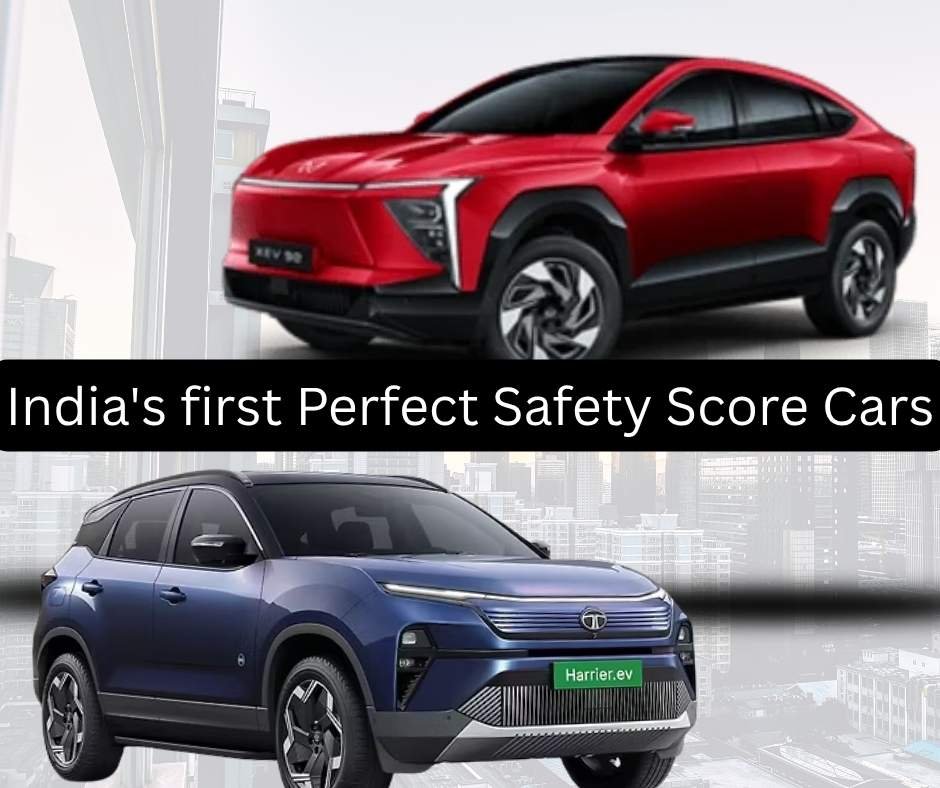
No other cars in India history have garnered a perfect Adult Occupant Protection rating of 32 out of 32 on the Bharat NCAP test than the Tata Harrier EV and Mahindra XEV 9e. They are both all-new full-size electric SUVs and both show the structural capability of a new purpose-built electric platform.
Tata Harrier EV–
Designed using Tata’s Gen 2 EV platform that positions the battery pack at the bottom of the car. The design significantly increases the chassis rigidity, lowers the vehicle’s centre of gravity and spreads out the crash forces throughout the vehicle. The outcome is outstanding overall integrity of the structure in both front and side collisions. When it comes to child occupant protection, the Harrier EV got 45 of 49 points, just like the top of the nation’s performers.
Mahindra XEV 9e-
Positions itself as a premium electric SUV and has achieved a perfect Adult Occupant Protection (AOP) score of 32 out of 32. Mahindra built the INGLO EV platform from the ground up with crash safety as a core focus, and the company now uses it in both the XEV 9e and the BE 6. The XEV 9e has become not only the safest Mahindra ever tested but also one of the safest cars ever sold in India by any manufacturer. The 6 airbags, electronic stability control, ISOFIX child seat mounts, TPMS and 3-point seatbelts for all occupants are standard on both models in all variants.
Why are Electric Cars Safer in Safety Tests?
One of the most frequently asked questions by buyers after visiting the Bharat NCAP ratings is this one. It’s about structural engineering, not equipment.
The engine compartment is located at the front of traditional petrol and diesel cars.Engineers design that bay to absorb and channel crash impact energy while protecting the passenger compartment. The main difference is that EVs use a “skateboard platform,” where manufacturers place the battery cells flat across the chassis between the axles. This layout has three significant safety benefits.
- First, the battery pack provides a rigid reinforcement of the spine of the car along its entire length. This makes it significantly stiffer when it comes to resisting twisting and deforming during impact – or torsional stiffness.
- Secondly, a low, center-mounted battery keeps the car low to the ground, which will lessen the chance of rolling the car during a high impact or emergency manoeuvre.
- Third, EVs usually feature a smaller front overhang since there’s no large engine that needs clearance. This provides engineers with the ability to create crumple zones that are longer and more effective to absorb more energy before it gets to the cabin.
This trend is further confirmed by the AOP score of 31.97 out of 32 on the Mahindra BE 6. India’s top three highest scoring cars are electric. This is no accident – it’s the result of engineering decisions made possible by EV platform architecture.
Kia Seltos 2026 is the safest ICE car in India.
If you’re still not ready for an EV, then the Kia Seltos is the vehicle to check out.
- Kia Seltos has achieved an impressive AOP score of 31.70 out of 32, making it the highest-rated internal combustion engine (ICE) vehicle tested by the Bharat NCAP. This achievement highlights the strong safety standards of the mass-market midsize SUV.
- The Seltos sits on Kia’s Advanced K3 platform, which gives the vehicle a modern design, and emphasises rigidity.
- The Seltos received a perfect rating of 16 out of 16 in the Bharat NCAP side impact test, which means there was no cabin damage whatsoever in a side impact crash.
- It earned 15.70 points out of 16 in the frontal offset test, missing by just 0.30 points from a perfect score.
- The Child Occupant Protection score was at 45 on 49 points, and is tied for the top COP among EV competitors.
- The tests were only carried out on the diesel variants of the HTE(O) and GTX but Bharat NCAP said the results would be valid for the full range of the Seltos.
- Buyers should keep in mind – it does not mean that you must pay more for the top trim to have the safety protection.
- The Seltos also has ISOFIX mounts, 6 airbags and ESC as standard equipment. Kia was the first brand to get a 5-star rating with the Syros and with the Seltos, it became the second 5-star model of the brand.
Other Safe Cars in India 2026
However, the top five are not the only ones to watch in the 2026 Bharat NCAP results.
Maruti Suzuki Victoris (31.66 AOP)
The Victoris marks a big step forward for Maruti Suzuki’s safety engineering, which has been a challenge in the past. Its close to optimum AOP rating indicates that the biggest carmaker in India has been attentive towards structural safety on its new generation car.
Tata Sierra (31.14 AOP, 44.73 COP)
The renewed Tata Sierra shows that good performance in both adult and child protection has earned it the rating of 5-star. The Sierra comes in 1.5-litre petrol, diesel and hybrid engines, with the rating valid for all.
Hyundai Venue (31.15 AOP, 44.46 COP)
Tata Punch holds the title of India’s most affordable 5-star safety-rated vehicle, starting at an on-road price of Rs 5.59 lakh. Tata includes 6 airbags, electronic stability control, and ISOFIX child-seat mounts as standard even in the base Smart variant. The vehicle also supports a TPMS for improved tyre pressure monitoring and added safety.
The Venue now comes standard with 6 airbags, ESC, ISOFIX, hill-start assist and TPMS, making it one of the safest compact SUVs in the country.
Tata Punch CNG (30.58 AOP, 45 COP)
The Tata Punch is India’s most affordable 5-star safety-rated vehicle, with a starting on-road price of Rs 5.59 lakh. Tata equips even the base Smart variant with 6 airbags, electronic stability control, and ISOFIX child-seat mounts as standard. The vehicle also supports a TPMS, which helps drivers monitor tyre pressure more effectively. Not many budget cars worldwide can offer that.
Renault Duster (30.49 AOP, 45 COP)
The new Duster earned 45 out of 49 COP points, or a full 5-star rating in April 2026. The Duster is outfitted with 6 airbags, ABS, ESP, Traction Control and TPMS as standard, making it a well-rounded choice for a family SUV.
Safety Features That Are Now Standard Across 5-Star Cars in 2026
One of the most impactful changes in the Indian automotive sector is the popularisation of safety. Upgraded options that used to only be offered on high-specification models are now offered throughout the entire lineup. So, for 5 star rated Bharat NCAP cars, there are some standard amenities that you can look forward to: 6 airbags, electronic stability control (ESC), ISOFIX child seat anchorage points, 3 point seatbelts with reminders on all 5 seats, tyre pressure monitoring system (TPMS) and ABS with EBD.
At the luxury level, Level 2 ADAS is now available in midsize and larger SUVs, and includes autonomous emergency braking, lane departure warning, adaptive cruise control, and 360-degree cameras. Together with the push from the regulation and the awareness among the consumers, these features are now more accessible than ever before in India’s automotive history.
How to Use Bharat NCAP Scores When Buying a Car
A star rating is only an indicator of category and not quite the full story. Do not view the AOP and COP scores together. Adult protection could be strong but child protection could be less — relevant if you travel a lot with children. Likewise, see if the rating is for all variants or specific trims. Manufacturers have started to ingrain safety standards in their product lines in most recent Bharat NCAP tests, but it’s advisable to verify before you buy.
On the data alone, Tata Harrier EV and Mahindra XEV 9e are the safest and score a perfect 10. The Kia Seltos is the standard for those who want to purchase an ICE car. The Tata Punch is a budget model that comes with 5 star protection. There’s a safe choice at all price points in 2026.
Conclusion
The 2026 Bharat NCAP scores are a game-changer in Indian automotive safety. Now, perfect scores are not just out of the question, they are a reality. But platform architecture and not simply the number of airbags is what makes a safe car a truly excellent one. The Kia Seltos has established a new benchmark for fuel-powered vehicles, and the Tata Punch’s affordable options have proven that safety doesn’t have to come with a hefty price tag. The data is easily accessible, visible, and clear for every Indian buyer who is about to take a decision in 2026. Use it. Now, the safest car in India is no compromise, but a real purchase.
FAQs on Safest Cars
Tata Harrier EV and Mahindra XEV 9e share the first rank with a 32 out of 32 ‘Adult Occupant Protection’ (AOP) rating for Bharat NCAP. When it comes to ICE (petrol/diesel) vehicles, the Kia Seltos has the highest AOP score of 31.70 out of 32.
Bharat NCAP is an official car safety assessment programme of India which was started in August 2023. It performs the following tests on cars: frontal offset crash test at 64 km/h, and side impact test at 50 km/h. Cars are scored on Adult Occupant Protection (out of 32) and Child Occupant Protection (out of 49). A minimum of 27 in AOP and 41 in COP is needed for a 5-star rating.
The EV has a skateboard platform with the battery pack mounted on the floor of the vehicle. This makes the chassis stiffer, lowers the centre of gravity and decreases crash energy to the cabin. Such benefits enable EVs to lower and spread crash forces better than many conventional ICE platforms.
The price range of the Tata Punch starts from around Rs 5.59 lakh, and is the cheapest 5-star Bharat NCAP rated car in India. Eighteen airbags, ESC, ISOFIX mounts and TPMS are standard, even on the base variant, making it an excellent safety value.
Yes. Under Bharat NCAP, the Kia Seltos has achieved a rating of 31.70 out of 32 in Adult Occupant Protection and 45 out of 49 in Child Occupant Protection. Took the side impact test with a score of 16/16. All variants are rated, and are fitted with 6 airbags, ESC and ISOFIX child seat mounts as standard.