Pull the hub off almost any trailer axle and you will find two bearings made of short, angled rollers in a cage, running inside a steel ring pressed into the hub. Those are tapered roller bearings. On trucks and trailers they do a job a plain ball bearing struggles with: carrying the weight of the load and the side force from turning at the same time.
Why the taper matters
A loaded wheel bearing sees two kinds of force. Radial load is the weight pressing down through the axle spindle. Axial load, or thrust, runs along the spindle: when the trailer turns or crosses a cambered road, the wheel tries to slide along the axle.
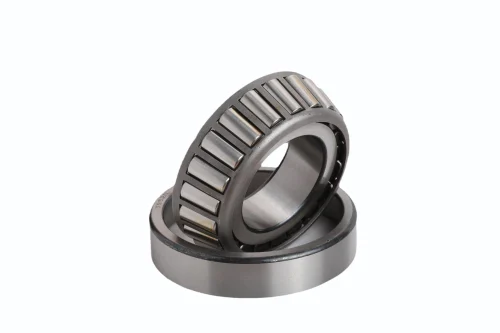
In a tapered roller bearing, the raceways on the inner ring (the cone) and the outer ring (the cup) are cut at an angle, and the rollers are tapered to match. The rollers make line contact on those angled raceways, so the bearing carries radial and axial load together. The steeper the contact angle, the more axial load it can take. In most designs the angle sits somewhere between 10° and 30°.
A single row tapered roller bearing takes thrust in one direction only. That is why a wheel hub uses two, an inner and an outer bearing facing opposite ways, to hold the wheel against side force from either direction.
Where you find them on trucks and trailers
- Wheel hubs on non-driven axles. Trailer axles and many truck steer axles carry the classic inner and outer pair, with the cones on the spindle and the cups pressed into the hub.
- Drive axle hubs. Many heavy trucks use the same two-bearing layout on driven wheels.
- Differentials. The pinion shaft and the differential carrier run on tapered roller bearings set with preload, so the gear mesh stays where it should under torque.
- Gearboxes and power take-off units, where helical gears push the shafts sideways.
Cup and cone: two parts, one job
A single row tapered roller bearing comes apart in your hands. The cone is the inner ring with the rollers and cage; the cup is the outer ring. On a trailer hub, the cups stay in the hub and the cones come out when you service it.
Metric bearings such as 30206 are sold as a cup-and-cone set under one ISO number. Hubs built to US inch standards often use separate numbers instead, such as an L44649 cone in an L44610 cup on many light trailer axles. Either way, replace the cup and the cone together. A new cone running on a pitted cup picks up the damage straight away.
Setting end play: where most hub problems start
A tapered roller bearing has no fixed internal clearance. On a wheel hub the clearance, called end play, is set by how far the spindle nut is tightened against the outer cone.
Too loose, and the wheel wobbles, the rollers load only part of the raceway and the seal wears unevenly. Too tight, and friction climbs, the grease thins and the hub overheats. Every axle maker publishes its own nut torque and back-off procedure; follow it rather than a rule of thumb.
Many newer heavy truck hubs come as pre-set assemblies, with end play controlled by a precision spacer. On those, the nut goes to one torque value and is not adjusted by feel.
When you repack a hub, work fresh grease into the cone by hand until it comes through between the rollers, and use the grease the axle maker specifies. Our tapered roller bearings usually ship with rust protection only; grease goes in at fitting.
Signs a tapered bearing is failing
- One hub is noticeably hotter than the others after a run.
- Grease is thrown onto the inside of the wheel or the brakes, usually through a failed seal.
- There is play when you lift the wheel and rock it at the 12 and 6 o’clock positions.
- A growl or rumble that changes with road speed, not with engine load.
- On boat trailers, milky grease: water has got past the seal.
Any of these calls for a teardown. On the cup raceway, frosting, pitting, flaking or blue and brown heat marks mean the bearing is done. In truck and trailer bearings returned to us, the usual story is a raceway dented by a jolt on a rough road. The rollers keep running over it, the damage spreads, and the whole bearing fails.
Buying replacement tapered roller bearings
Metric tapered roller bearings follow the boundary dimensions in ISO 355, so a 30206 from one maker fits the same spindle and hub as a 30206 from another: 30 mm bore, 62 mm outside diameter and 17.25 mm total width with cup and cone assembled. Ask about the rest in writing before a first order:
- Steel. Rings and rollers should be bearing steel, for example GCr15 chrome steel, which is close to 52100.
- Cone width B. For a few sizes, cone width differs between makers even when the other dimensions match. Check it if the shaft shoulder is tight.
- Precision class. P0 is the normal class; write the class on the order.
- Load ratings. These are not fixed by the ISO number, so compare them between suppliers.
- Inspection scope. Ask what the report covers: dimensions, rotation noise, appearance and batch traceability at least.
Our factory in Linqing, Shandong makes metric single row tapered roller bearings in the 30200, 30300 and 32200 series, supplied as complete cup-and-cone sets. If a customer specifies part widths or the assembled width T, each set is checked on a height gauge. Bore, outside diameter and width for each size are listed on the FULI tapered roller bearings page, and the rest of the range is at www.fuli-bearings.com.
The bearing number gets the right part into your hand. The end play you set and the grease you pack decide how it runs.