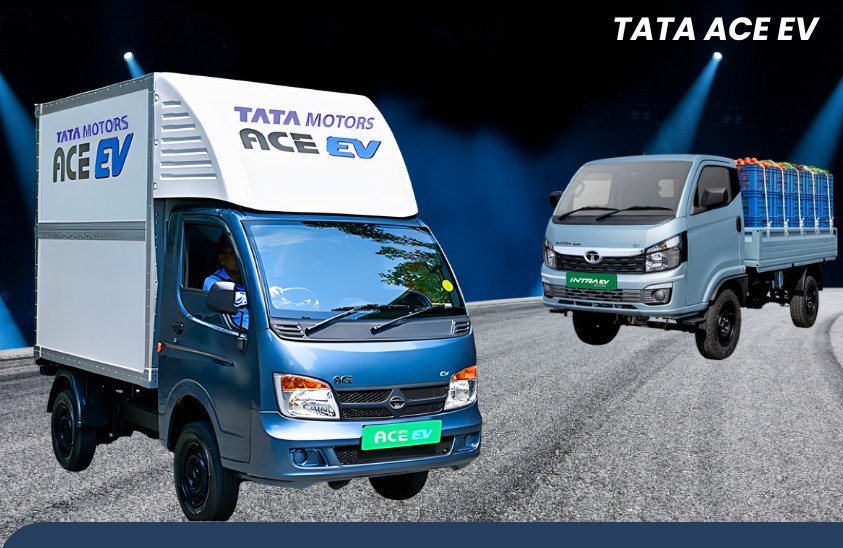
The increasing cost of fuel is affecting small business owners and last-mile delivery companies in India, making diesel mini trucks unaffordable. The Tata Ace EV, unveiled on May 5, 2022 by Tata Motors, is a direct response to this problem, providing an affordable zero-emission electric product designed for today’s commercial uses. Tailored for urban cargo transport applications like e-commerce, FMCG, courier and city logistics, it features a low cost of operation (Rs 1 per km) vs Rs 4-5 per km for diesel mini trucks.
Thus, it is a lucrative long-term investment for fleet operators and SMEs. Featuring Tata’s EVOGEN technology with a 27 kW power and 130 Nm torque producing 21.3 kWh Lithium Iron Phosphate battery, the Ace EV has an ARAI range of 154 km and a top speed of 60 kmph.
The Tata Ace EV ex-showroom price is around Rs 10.20 lakh, which can differ based on state subsidies. It also features rapid charging (10-80%) in 105 minutes, allowing fleets to be on the road for most of the day with little downtime.
This article will provide complete information about Tata Ace EV, on road price, variants, mileage, engine, interior, exterior, safety features, competitors and more.
Tata Company: Overview
One such name, which is trusted and age-old in the automotive industry around the world, especially in the commercial vehicle classification is Tata Motors. By being a subsidiary of the Tata Group, the company has established itself as a reputable company in producing reliable, durable, and affordable vehicles that serve an extensive customer base; individual transporters up to large fleet operators. Tata Motors has been known to greatly contribute to forming the logistic and transportation ecosystem of India, over the years with some of its products such as the Tata Ace being associated with the concept of mobility of small business.
The Tata Ace EV is an extension of Tata Motors innovativeness and sustainability endeavors. The company has aggressively been investing in electric mobilities not only in passenger cars but also in commercial usage. These involve the creation of the advanced battery technology, the establishment of charging infrastructure alliances, and provision of integrated fleets. One of the components of this strategy is the Ace EV, which seeks to make the last-mile delivery process electric and cut down on carbon footprint of logistics operations.
| Parameter | Details |
| Company Name | Tata Motors Limited |
| Segment | Commercial Vehicles & EVs |
| Product Line | Tata Ace Series |
| EV Focus | SCVs, buses, passenger EVs |
| Market Position | Leader in SCV segment |
| Service Network | Nationwide presence |
Tata Ace EV Price and Variants
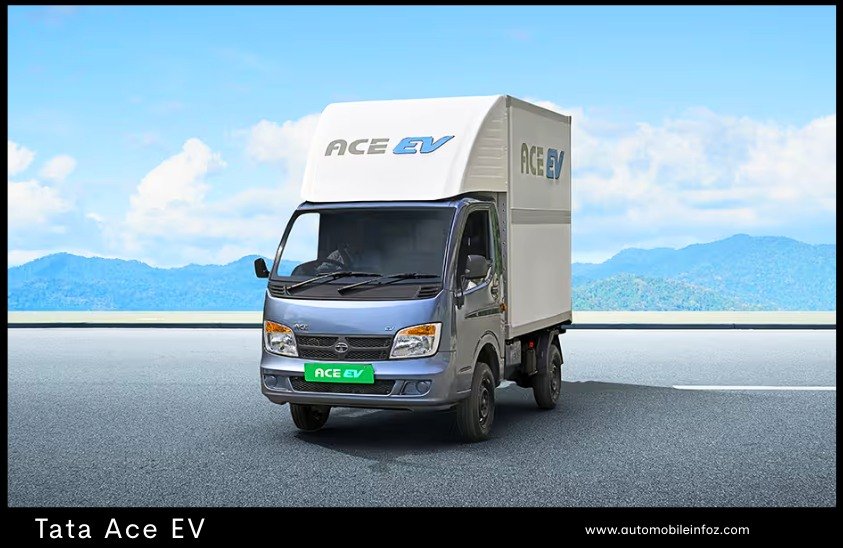
The Tata Ace EV is priced high based on the level of electric technology, and the modern design it has. Although it is costlier in the short term than diesel mini trucks, it will save a lot of money in the long term due to low operating and maintenance expenses. The car is equipped with various variants, this time primarily determining them according to their payload capacity and type of body. The normal Ace EV is fitted to the lighter delivery missions whereas the Ace EV 1000 suits the companies requiring greater payload capacity and volume capacity.
In the on-road price, the buyers are supposed to know that the last price has a number of factors behind it that include ex-showroom price, road tax (where necessary), insurance, registration fees and dealer handling charges. Some states also have subsidies and tax exemptions on electric vehicles, which can help lower the overall cost. Nevertheless, these benefits are not the same in each state, and thus before deciding to purchase an item, one should look at existing policies locally.
In the case of fleet operators, the high initial cost can be reasonably offset by the savings achieved in the long run in fuel and maintenance. The decreased price per kilometer can compensate the increased price of purchase over time, and therefore, the Ace EV will be a financially viable alternative among businesses that use it on a regular basis.
| Model Name | Payload Capacity | Gross Vehicle Weight (GVW) | Range | Ex-Showroom Price (Approx.) |
| Tata Ace Pro EV | 750 kg | 1610 kg | 155 km | ₹6.50 Lakh – ₹6.82 Lakh |
| Tata Ace EV | 600 kg | 1840 kg | 154 km | ₹10.51 Lakh – ₹11.43 Lakh |
| Tata Ace EV 1000 | 1000 kg | 2120 kg | 161 km | ₹11.30 Lakh – ₹11.50 Lakh |
Tata Ace EV On Road Price In India (City wise)
The Tata Ace EV on road price differs between cities in India, depending on the state’s road tax, RTO fees, insurance, and EV subsidies. The Tata Ace EV ex-showroom price ranges from Rs 10.20 lakh to Rs 11.43 lakh (depending on the variant).
New Delhi – The lowest prices are found in New Delhi at around Rs 10.50 lakh due to the city’s generous EV policy that exempts road tax and RTO charges.
Mumbai – The price in Mumbai is around Rs 10.80 to 11.10 lakh.
Bengaluru – In Bengaluru, prices range from Rs 10.75 to 11.00 lakh.
Chennai – In Chennai, prices range from Rs 10.90 to 11.20 lakh, influenced by Tamil Nadu’s RTO.
Hyderabad – Hyderabad’s prices are around Rs 10.70 to 11.00 lakh, driven by Telangana’s EV promotion.
Kolkata – Kolkata’s prices range from Rs 10.85-11.15 lakh.
Pune – In Pune, prices range from Rs 10.75-11.05 lakh.
Ahmedabad – Ahmedabad continues to have the lowest price at Rs 10.60 to 10.90 lakh due to the favourable EV subsidy policy in Gujarat.
Jaipur and Lucknow – The remaining two top-ten cities, Jaipur and Lucknow, have prices at around Rs 10.65 to 11.00 lakh and Rs 10.70 to 11.05 lakh respectively.
Consumers should check with their local authorised Tata Motors dealer for the latest prices.
Tata Ace EV Top Speed, Engine & Performance
The Tata Ace EV not only has an electric motor in place of the conventional internal combustion engine, but it represents a substantial change in the functioning of commercial vehicles. It has an induction motor of 27 kW (AC) with a 21.3 kWh lithium-ion battery pack. This arrangement provides approximately 130 Nm of torque, and this is supplied immediately as compared to the diesel engine, which takes time to gain power. This instant torque becomes more advantageous when driving in cities where it happens that the frequent stops and starts are frequent.
| Parameter | Specification |
| Motor Type | AC Induction Motor |
| Battery Capacity | 21.3 kWh |
| Power | 27 kW (~36 HP) |
| Torque | 130 Nm |
| Top Speed | 60 km/h |
| 0–60 km/h | ~15–18 sec |
| Gradeability | 20–22% |
Tata Ace EV Mileage & Fuel Economy
Tata Ace EV has a certified range of about 154 to 161km on full charge and is sufficiently good to cover most of the daily delivery in urban areas, the vehicle is very adequate. On the road, the actual range may differ with regard to the weight of the load, the driving style, the state of traffic and the terrain.
It has a low cost of running which is one of its largest strengths. It is estimated to cost between ₹130-150 to charge the battery over 100 km, much less than diesel since over 100km may cost ₹300-400 and above diesel. This difference can save a lot of money in the long run, particularly when compared to enterprises that use vehicles in the day to day running.
| Parameter | Value |
| Range per Charge | 154 – 161 km |
| Charging Time | ~6–7 hours |
| Cost per 100 km | ₹130 – ₹150 |
| Fuel Type | Electricity |
Off-Road Hardware & Capability
The Tata Ace EV will be mostly used in the city and semi-urban areas, although it can work on slightly uneven roads. Its suspension framework, comprising of leaf springs, is designed in a way that it is able to absorb shocks and ensure the stability even when the car is fully loaded.
The clearance of the vehicle is sufficient to navigate past the speed breakers, potholes and other uneven roads that are usual in Indian cities. Moreover, it is gradeable thereby, should be able to climb ramps, flyovers, etc without loss of power.
Nevertheless, it is necessary to mention that the Ace EV is not made to operate in hard off-road environments (e.g., muddy roads, rocky paths). Its shape is no longer about rugged off road capabilities but practicality and efficiency.
| Feature | Specification |
| Suspension | Leaf spring |
| Ground Clearance | Suitable for city roads |
| Gradeability | 20–22% |
| Drive Type | Rear-wheel drive |
Tata Ace EV Interior & Features
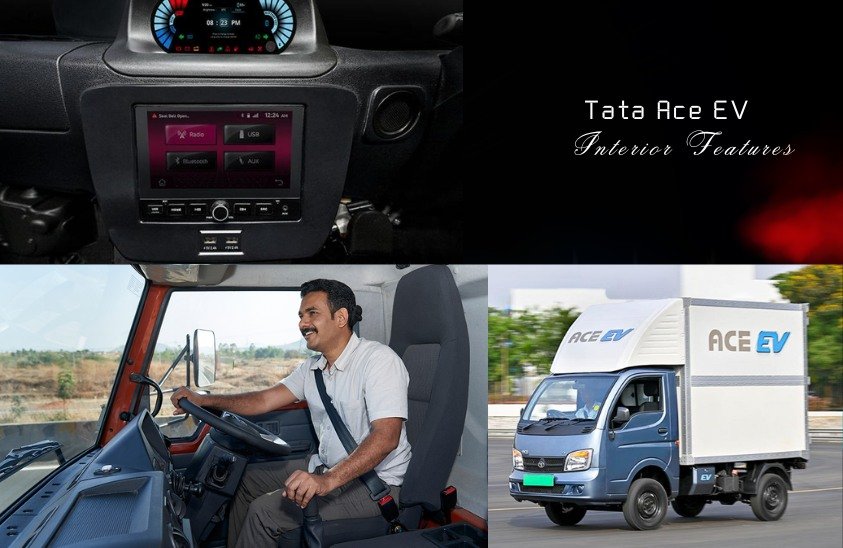
The Tata Ace EV has an interior that is simply and functional. It has a two seater cabin with a bench-style seat that is comfortable enough on short to medium journeys. The design is simple and all the controls are convenient to the driver.
The major feature of the Ace EV that should be listed as one of its main benefits is the absence of a clutch. As it has a single-speed electric drive system it does not need to change gears hence easier to drive, particularly during heavy traffic conditions.
| Feature | Details |
| Seating | 2-seater |
| Steering | Mechanical |
| Transmission | Automatic (EV drive) |
| Display | Digital cluster |
| Storage | Utility spaces |
Ace EV Exterior Design Highlights
The Tata Ace EV has the same design as the original Ace with slight modifications to project its electric nature. Its small size also makes it perfect to maneuver through busy streets and narrow areas.
The vehicle has a wide range of body structure such as flatbed and deck body that enables the businesses to select the alternative that suits them best.
| Feature | Details |
| Design | Compact |
| Body Type | Flatbed / Deck |
| Turning Radius | ~4.3 m |
| Build Quality | Strong |
Tata Ace EV Safety Features
The Tata Ace EV is considered safe by giving health care to such areas as braking, structural power, and battery safety. This car has front disc brakes and rear drum brakes to ensure high braking power.
The battery system has thermal management and safety measures to avoid overheating and to operate safely.
| Feature | Details |
| Brakes | Disc & Drum |
| Battery Safety | Thermal protection |
| Stability | Strong chassis |
| Visibility | Wide windshield |
Charging Infrastructure
The Tata Ace EV offers three flexible charging options for various use cases. With a 15A socket, it takes six to seven hours for a full charge, making it convenient for small businesses to charge overnight. Using a 6.6 kW wall charger takes around three hours. DC fast charging is the quickest, with a 10-80% charge in 105 minutes, allowing for less fleet downtime. Tata has tied up with Tata Power’s EZ Charge network, which includes more than 5,500 charging points in 620 cities in India, including 200 fast-charging points for electric commercial vehicles in tier-1 cities.
Battery Warranty and Lifecycle
The Tata Ace EV offers a robust battery warranty, offering peace of mind to fleet operators and small businesses. The high-voltage battery (Lithium Iron Phosphate) is warranted for 7 years or 1,75,000 km, whichever occurs first. LFP batteries have good thermal stability, long cycle life and reliable performance even after long-days of operation. The IP67 battery and motor protection ensure safe and consistent performance in all weather conditions in India. Liquid-cooled battery in the Ace EV 1000 model further enhances battery safety and life. Tata also has an extended warranty plan for higher coverage.
Service and Maintenance
The major benefit of the Tata Ace EV over its diesel counterparts is its low maintenance cost. The simplicity of the electric drivetrain means that there is no need to change engine oil, coolant or the clutch, which brings down maintenance costs. Tata Motors provides the Ace EV with more than 150 Electric Vehicles Service centres in India, equipped with trained EV technicians. The Fleet Edge telematics system built into all Ace EVs offers live tracking, battery status monitoring and driver behaviour insights, allowing predictive maintenance. Tata also provides a five-year maintenance solution package and door-to-door service to authorised centres for the convenience of operators.
Reviews and Ratings
Small entrepreneurs and fleet operators in India have been pleased with the Tata Ace EV. Popular feedback includes quiet and comfortable driving, low cost of operation (about Rs 1 per km) and adequate battery range for a day of city deliveries. One owner of a courier business reports that running costs have fallen by almost 70% compared to diesel. But some note higher initial cost, deterring buyers. It is rated highly for its quality, comfort and environmental impact. On average, the Tata Ace EV scores well around 4.2 out of 5 across key commercial vehicle reviews, making it an ideal last-mile electric vehicle.
Ride & Handling
Ace EV the driving experience is smooth and quiet as compared to that of the diesel vehicles. The feature of the engine-noise and vibrations makes the working experience more comfortable, particularly when working long hours. It is simple to navigate through the city traffic due to its small size and light steering.
| Aspect | Performance |
| Ride Quality | Smooth |
| Handling | Easy |
| Noise Level | Low |
| City Driving | Excellent |
Tata Ace EV Competitors Comparison
The Tata Ace EV is competing with Mahindra Jeeto Electric or Mahindra Supro that has diesel options. Although diesel cars cost less initially, EV vehicles are more cost-effective in the long term.
| Model | Fuel | Range | Price |
| Tata Ace EV | Electric | 154 km | ₹10.5L+ |
| Mahindra Jeeto EV | Electric | ~120 km | Lower |
| Mahindra Supro | Diesel | NA | ₹5–6L |
Buying Guide
In deciding to buy the Tata Ace EV, you need to launch your choice on the basis of your day by day business activities, range of the route and accessibility of the charging station. In a business where you cover routes within the city that are predictable with 120-150 km per day like e-commerce delivery, the distribution of the FMCG, milk distribution, or a kirana business, then the Ace EV is better suited as it has very low operating costs and it does not stick during traffic jams.
This vehicle will have the greatest benefit on businesses that have fixed routes, and can have overnight charging (home, warehouse, or depot). Nonetheless, in the cases when long-range movement or inter-city transportation is involved or an unpredictable route causes sparse places of charging stations, then a diesel type could remain a viable option.
Also the payload requirement needs to be taken into consideration- in case you have less frequent heavy loads to be performed, an Ace EV 1000 version would be more appropriate since it has a greater capacity. Always check your charge infrastructure availability in your location, financing or leasing, and service after sales services provided by Tata Motors.
Conclusion
Tata Ace EV is a prospective of a commercial car that is a perfect match to the future of our urban logistics and sustainable transportation. It has been able to replace the old diesel-dependent system with a cheaper, mellower and more efficient electric system. Though the initial cost will be high, the future savings in fuel usage, maintenance and operational efficiency make it a good investment to businesses whose businesses use vehicle on a daily basis.
The Ace EV is particularly useful in last-mile delivery and logistics operations as its practical range, high load carrying capacity and capability in urban environments give it a major advantage over its rivals. It provides a balanced performance, savings, and sustainability to fleet owners and small business operators interested in cutting costs and implementing eco-friendly options. With India still trying to drive towards electric mobility, Tata Ace EV is one of the most reliable and future-proof options offered in the small commercial segment.
FAQs
Tata Ace EV price in India begins at approximately ₹10.5 lakh (ex-showroom) and may increase to 13.5 lakh on-road (depending on the model and location).
The Tata Ace EV series covers between 154 and 161 km in a fully charged condition in ideal conditions.
Yes, Tata Ace EV delivery business best suits the situation because of its low cost of running, easy ride and aptness in the city routes.
The charging time of Tata Ace EV is approximately 6 to 7 hours when it is charged with a standard charger.
Ace EV has the same payload capacity of 700 kg in the higher Ace EV 1000 model.
Also, Read About –
Eicher Pro X: Price, Variants, Mileage, Top Speed, Interior, Safety Features, Specs & More