Step into a classroom of engineering students in India today and there’s been a subtle change. Students are not only reading about Betz’s law and mechanisms for pitch control, they’re conducting experiments on a real turbine setup, are recording the power curve, and they’re troubleshooting inverter faults live. This change wasn’t a coincidence. Energy engineering education has begun to be affected by the purpose-built wind labs, which are now beginning to be found in technical institutions around the world.
The Gap that Classroom Theory Could NOT Fill
In India, the engineering colleges have always provided courses on renewable energy, albeit superficially. For many years, the way the problem was presented in textbooks was in the form of equations and diagrams in a slide show. A student might learn the theoretical capacity factor of a wind turbine and not have used an anemometer or even read the power output curve on a wind turbine. That gap was important, particularly in the start of India’s wind industry’s significant growth.
As of early 2024, India was one of the world’s largest wind markets with 47 GW of installed capacity. The industry requires engineers to not only compute these but also commission, maintain and optimise them. Those colleges that focus on theory alone are churning out people who require months of training at the work place before they are able to be used.
What is a Wind Lab, anyway, that does things differently?
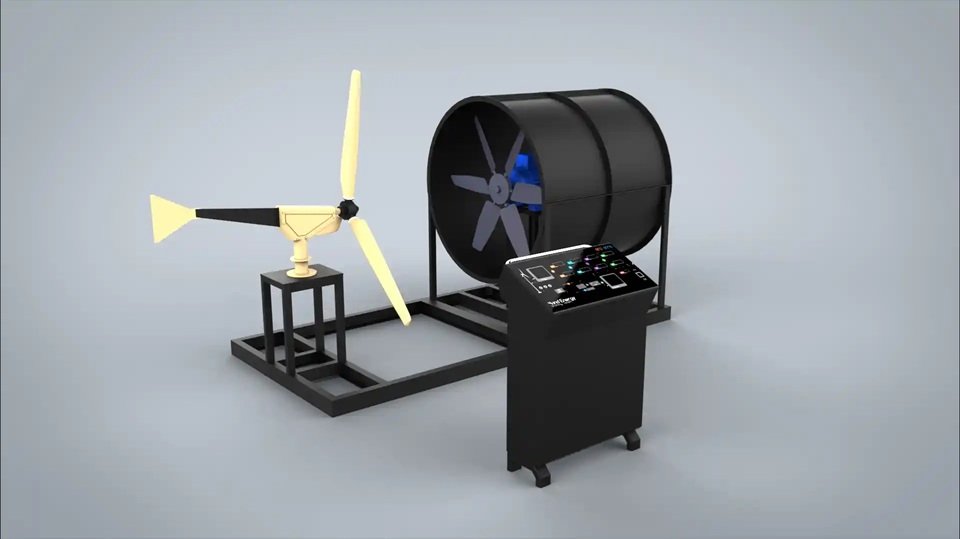
A well equipped wind lab alters teaching and learning in a unique way. Provides students with measurable variables. A student can control the wind speed (by controlling the airflow) and record the rpm of the turbine, measure the actual wattage and observe where the curve fails. This is another learn-to-understand.
Most wind labs are using the scaled wind turbine trainers, data acquisition systems, variable load banks and grid synchronisation modules. In some configurations the solar input can also be connected in parallel with the wind source with hybrid integration panels, which represent an actual hybrid configuration of a power plant. Just like field engineers, students get the same fault conditions, measurement problems and control decisions when working on these setups but in a repeatable and controlled environment.
That’s more than a serious statement about the importance of repeatability. A student is given the possibility of performing the same experiment with varying parameters for a total of six trials, to compare the results and to make judgment. This isn’t an option if you’re using a slide with a diagram as a source of reference.
These Labs are being utilized in a variety of ways by institutions
All over in states like Tamil nadu, Rajasthan, Maharashtra and Gujarat where wind resources are abundant, colleges have initiated to establish wind labs in their power systems and electrical engineering courses. Others are simply turning them into electives lab spaces. Others have integrated them into a standard curriculum course for energy systems or smart grid courses.
It’s interesting how faculty are adapting. For some institutions, wind lab equipment has been used as the basis for a student project which they submit to a competition such as the Smart India Hackathon or IEEE student events. A lab that was bought for use by under-graduates then produces paper presentations, final year projects and sometimes even funded research proposals for the final year.
One of the lesser discussed advantages of investing in a hands on infrastructure is this spillover effect. Equipment to teach undergraduates also provides a testbed to postgraduate students. It also provides faculty with something to focus their applied research around.
The angle between the industry and the reference
Employers in India’s renewable energy industry, such as EPCs, IPPs and O&M companies have not only begun to pay more attention to the score that candidates achieved, but to the methods in which they were trained. If a candidate has set-up a pitch angle controller on a turbine in the laboratory, or mapped efficiency against wind speed variation, he or she will have something to show in a technical interview to document.
This is driving more placement conscious institutions to act as differentiators in terms of their lab infrastructure. It isn’t simply a concern with equipment being listed in an accreditation document. It’s whether or not students can use it. Interested colleges are having a smoother ride to establish MoUs with the renewable energy industry for internship pipeline. Businesses receive less hand holding in the form of candidates. Colleges receive placement information which aids in recruiting.
The next steps in the process
The growth of wind labs in India is still in an uneven manner. Good provision of quality equipment in well-funded autonomous institutions in tier-1 cities. Despite the fact that government colleges in smaller towns, where the wind potential is highest, are yet to get the modern and complete laboratory setup. It is important because the next generation of wind deployment is expected to enter into new markets and local engineering talent must be developed to successfully increase wind installations.
AICTE has incorporated renewable energy practicals in its model curriculum for electrical and power engineering programmes but it will need institutional leadership and appropriate partnerships with vendors to get the funding and the equipment set out for the labs.
Where colleges are prepared to make that transition, the rewards are tangible: in terms of the outcomes of their students, in research done by their faculty, and in the type of graduates India’s energy transition needs.
Also, Read –