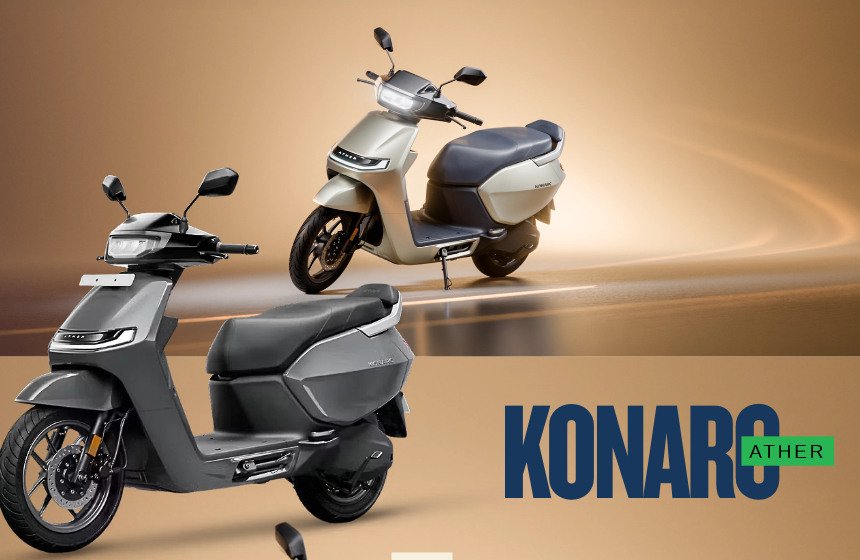
The Ather Konarc is an electric scooter from Ather Energy designed for Indian commuters who want practical features, comfortable riding, and lower running costs. Introduced in August 2026, the Konarc is built on the company’s EL platform and combines a metal body, steel unibody chassis, long-travel suspension, and a focus on everyday convenience.
The scooter is offered under the S and Z product lines, with different battery and feature configurations for various commuting needs. The S range includes four advertised IDC range options: 100 km, 125 km, 161 km and 200 km. The Z range is planned with 125 km and 161 km options and additional premium features.
With an advertised top speed of up to 80 km/h for the Z line, a maximum claimed IDC range of 200 km and practical storage, the Konarc targets buyers looking for an alternative to the TVS iQube, Bajaj Chetak and Ather Rizta. However, buyers should remember that the advertised IDC range and actual riding range can differ considerably.
What is Ather Konarc?
The Ather Konarc is an electric scooter built by Ather Energy for daily commuting and family rides. It will be introduced in 2026 and will have a metal body, steel unibody chassis, long-travel suspension, and 14-inch wheels. The scooter will come in several battery and range combinations, with the higher-range version expected to be available, offering a claimed IDC range of up to 200 km.
The price of the ex-showroom starts at ₹99,999 as of October 2026. The on-road price of the model in India ranges from city to city and variant to variant and starts from approximately ₹1.07 lakh and goes up to approximately ₹1.51 lakh for the 161 km variant in some cities. This fee is usually inclusive of insurance and registration fees as appropriate.
The Konarc is good for all those who want to get their electric scooter for everyday use, offering significantly lower operating costs than petrol scooters. However, real-world range depends heavily on actual riding style, road conditions, and loading.
Ather Company: Overview
Ather Energy is an Indian electric two-wheeler manufacturer known for developing electric scooters, charging infrastructure, and connected vehicle technology. Its product portfolio includes the performance-focused Ather 450 series, the family-oriented Rizta, and the Konarc, which targets practical everyday mobility.
The Konarc introduces the company’s EL platform to a wider market. Its main highlights include a steel unibody chassis, metal body panels, a 14-inch front wheel, long-travel suspension, and a focus on convenient ownership. Ather also advertises a service interval of once every 12 months or 10,000 km, whichever comes first.
| Particulars | Details |
| Company name | Ather Energy |
| Scooter name | Ather Konarc |
| Vehicle category | Electric scooter |
| Platform | EL platform |
| Launch | August 2026 |
| Starting ex-showroom price | ₹99,999 |
| Maximum advertised IDC range | 200 km |
| Maximum advertised top speed | 80 km/h for the Z line |
| Body construction | Metal body with steel unibody chassis |
| Front wheel | 14-inch alloy wheel |
| Underseat storage | 31 litres |
| Front storage | 2 litres |
| Main purpose | Daily commuting and family use |
Ather Konarc On-Road Price and Variants-wise
The Ather Konarc’s price depends on its battery configuration, features, and city-specific registration charges. The S range includes four announced configurations, while the Z range is planned with two variants featuring additional equipment.
The introductory ex-showroom price starts at ₹99,999. Prices vary according to battery capacity, and the higher-range versions cost more. Buyers should confirm the final price and availability with an authorised Ather dealer before booking.
| Variant | Advertised IDC Range | Ex-Showroom Price | Indicative On-Road Price |
| Konarc S 100 km | 100 km | ₹99,999 | Not confirmed |
| Konarc S 125 km | 125 km | ₹1,21,999 | Around ₹1.32 lakh |
| Konarc S 161 km | 161 km | ₹1,44,999 | Around ₹1.57 lakh |
| Konarc S 200 km | 200 km | Not announced | Not announced |
| Konarc Z 125 km | 125 km | Not announced | Not announced |
| Konarc Z 161 km | 161 km | Not announced | Not announced |
Ather Konarc Engine, Performance & Top Speed
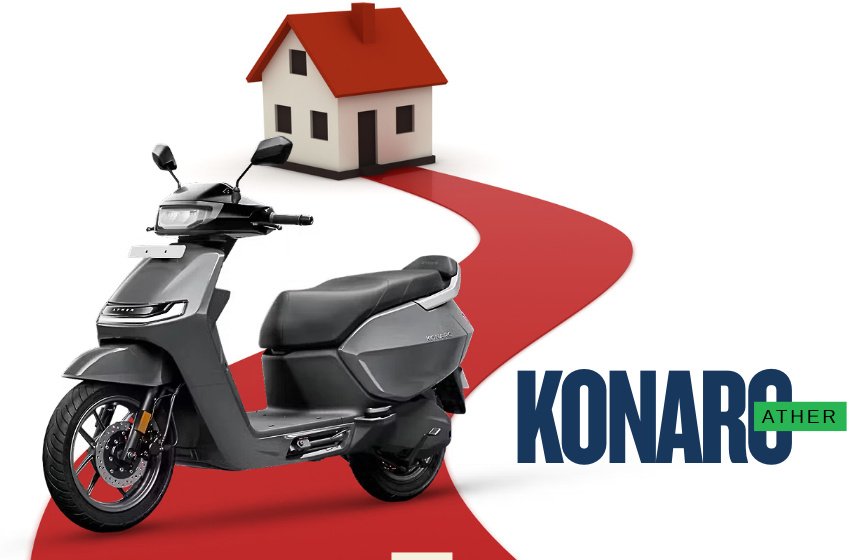
The Ather Konarc uses an electric motor instead of a conventional petrol engine. Its electric powertrain provides instant torque, helping riders accelerate smoothly from traffic signals and navigate congested roads.
The published specifications indicate that the larger battery configurations offer motor output of up to 4.7 kW and peak torque of 16 Nm. Performance and top speed vary according to the selected variant. Battery and motor specifications marked with an asterisk are based on published specifications for the corresponding battery configurations. Final specifications should be verified for each variant.
Ather has not published a verified 0–100 km/h acceleration time. Since the scooter’s maximum speed is below 100 km/h, this acceleration measurement is not applicable to the listed configurations.
The Konarc is designed primarily for urban commuting rather than high-speed performance. Its electric motor and automatic transmission should make it convenient for everyday traffic conditions.
| Specification | Konarc S 100 km | Konarc S 125 km | Konarc S 161 km | Konarc S 200 km | Konarc Z Range |
| Powertrain | Electric | Electric | Electric | Electric | Electric |
| Battery capacity | 2.1 kWh* | 2.7 kWh* | 3.5 kWh* | Not confirmed | Not confirmed |
| Maximum motor power | 4 kW* | 4.7 kW* | 4.7 kW* | Not confirmed | Not confirmed |
| Peak torque | 16 Nm* | 16 Nm* | 16 Nm* | Not confirmed | Not confirmed |
| Top speed | 70 km/h | 70 km/h | 70 km/h | 70 km/h | 80 km/h |
| 0–100 km/h acceleration | Not published | Not published | Not published | Not published | Not published |
| Transmission | Automatic | Automatic | Automatic | Automatic | Automatic |
Konarc Mileage & Fuel Economy
The Ather Konarc does not use petrol, so its efficiency depends on battery capacity, electricity consumption, and riding conditions. Ather advertises IDC ranges of 100 km, 125 km, 161 km, and 200 km across the S range.
However, the distance covered in everyday conditions can be lower than the advertised IDC figure. Riding speed, passenger weight, road conditions, temperature, and acceleration habits all affect the actual range. The 125 km version may be sufficient for daily commuting over short and medium distances. Riders who travel longer distances or want fewer charging sessions should consider the 161 km version.
Electricity costs also depend on the local tariff and charging efficiency. Home charging can make daily commuting economical compared with running a petrol scooter.
| Variant | Advertised IDC Range | Advertised TrueRange |
| Konarc S 100 km | 100 km | Not published |
| Konarc S 125 km | 125 km | 100 km |
| Konarc S 161 km | 161 km | 130 km |
| Konarc S 200 km | 200 km | Not published |
| Konarc Z 125 km | 125 km | Not published |
| Konarc Z 161 km | 161 km | Not published |
Off-Road Hardware & Capability
The Ather Konarc is designed primarily for urban roads, residential streets and everyday commuting. Its larger front wheel and long-travel suspension are intended to improve comfort over potholes, uneven surfaces, and speed breakers. The Konarc may handle ordinary broken roads comfortably, but it is not designed for serious off-roading. Deep mud, rocky trails, and loose gravel can challenge its traction and ground clearance.
Buyers who regularly travel on rough roads should check the scooter’s ground clearance and suspension performance during a test ride.
| Hardware | Details |
| Front wheel | 14-inch alloy |
| Rear wheel | 12-inch wheel |
| Suspension | Long-travel setup |
| Chassis | Steel unibody |
| Body panels | Metal |
| Primary use | Urban roads and everyday commuting |
| Off-road suitability | Limited |
Ather Konarc Interior & Features
The Ather Konarc focuses on convenience, storage, and connected technology. Its equipment varies by variant, allowing buyers to choose between a simpler configuration and a more feature-rich version. The 31-litre underseat storage compartment provides space for everyday belongings. Ather states that it can accommodate up to two half-face helmets, depending on their size and shape. The separate 2-litre front compartment provides additional convenience.
The DeepView display focuses on essential riding information, while the Z line targets buyers who prefer a more advanced touchscreen interface.
| Feature | Konarc S | Konarc Z |
| Dashboard | DeepView display | TFT touchscreen |
| Navigation | Depends on configuration | Google Maps-based navigation |
| AutoHold | Available feature | Available feature |
| Theft and tow alerts | Connected features, subject to configuration | Connected features, subject to configuration |
| MagicKey | Not listed for S | Planned Z-line feature |
| Underseat storage | 31 litres | 31 litres |
| Front storage | 2 litres | 2 litres |
| USB charging | Confirm availability | Confirm availability |
Konarc Exterior Design Highlights
The Ather Konarc combines a practical scooter design with metal body panels and a steel unibody chassis. Its construction and styling aim to provide a balance between durability, convenience, and a premium appearance.
| Exterior Element | Details |
| Body construction | Metal body panels |
| Chassis | Steel unibody |
| Front wheel | 14-inch alloy |
| Rear wheel | 12-inch wheel |
| Colours | Quartz White, Lumen Copper, Celestial Gold and Majestic Grey |
| Additional Z colours | Steel Blue and Claret Red announced |
| Design focus | Practicality and everyday usability |
Ather Konarc Safety Features
Safety is important when selecting an electric scooter for everyday commuting. The Konarc offers a combination of structural, braking, and connected security features, although availability varies by variant.
| Safety or Security Feature | Details |
| Steel unibody chassis | Structural body construction |
| Advanced Electronic Braking System | Announced for the Z line |
| Front disc brake | Listed for higher battery configurations in published specifications |
| Rear drum brake | Listed in published S-variant specifications |
| Theft and tow alerts | Notifications for detected movement or towing |
| AutoHold | Helps hold the scooter on slopes and at stops |
| Connected security features | Availability depends on configuration |
Ride & Handling
The Konarc’s 14-inch front wheel and long-travel suspension are intended to improve everyday ride comfort. These components should help the scooter handle ordinary road imperfections more comfortably.
The electric powertrain also makes stop-and-go traffic easier because riders do not need to operate a clutch or change gears. Its steel unibody construction provides a sturdy structural base.
| Riding Factor | Expected Benefit |
| Long-travel suspension | Helps absorb road imperfections |
| 14-inch front wheel | Supports everyday road stability |
| Electric motor | Smooth power delivery |
| Automatic transmission | Convenient city riding |
| AutoHold | Helpful on slopes and at stops |
| Steel chassis | Robust construction |
Ather Konarc Competitors Comparison
The Ather Konarc competes with several electric scooters in India, including the TVS iQube, TVS Orbiter, Bajaj Chetak, and Ather Rizta.
Each model offers a different combination of range, storage, features, and design. Buyers should compare equivalent variants rather than relying only on starting prices.
| Scooter | Main Strength | Best Suited For |
| Ather Konarc | Metal body, steel chassis, and long-travel suspension | Practical everyday commuting |
| Ather Rizta | Family-focused design and storage | Families and daily errands |
| TVS iQube | Mainstream electric scooter range | Everyday urban travel |
| TVS Orbiter | Practical urban mobility | Daily commuters |
| Bajaj Chetak | Metal-bodied design and premium styling | Buyers prioritising construction and appearance |
Ownership Cost & Maintenance
Electric scooters can reduce everyday running costs because they do not require petrol or routine engine oil changes. However, owners still need to budget for electricity, tyres, brakes, insurance and repairs.
Ather advertises routine servicing once every 12 months or 10,000 km, whichever comes first. Battery warranty options depend on the selected package and its terms.
| Ownership Factor | Details |
| Energy source | Electricity |
| Routine service interval | 12 months or 10,000 km |
| Standard battery warranty | 3 years or 30,000 km |
| AtherStack Pro battery coverage | 5 years or 60,000 km, subject to terms |
| Optional extended battery warranty | Up to 10 years or 1,00,000 km, subject to eligibility |
| Engine oil changes | Not required |
| Other expenses | Insurance, tyres, brakes and repairs |
Buying Advice
The right Ather Konarc variant depends on your daily travel distance, charging arrangements and preferred features.
| Buyer Type | Buying Recommendation |
| Short-distance commuter | Consider the 125 km IDC variant if available |
| Regular long-distance commuter | Consider the 161 km IDC variant |
| Technology-focused buyer | Compare the Z line after final pricing is announced |
| Budget-conscious buyer | Compare the entry-level variant with competitors |
| Rider without home charging | Check public charging availability first |
| Family buyer | Test passenger comfort and storage capacity |
Before booking, confirm the variant’s availability, final on-road price, charging equipment, battery warranty, and delivery timeline. Treat unpriced configurations as upcoming options until their availability is officially confirmed.
Verdict
The Ather Konarc is a promising electric scooter for Indian commuters who want practical storage, metal body construction, a steel unibody chassis, and comfort-oriented hardware. Its advertised range options offer flexibility, while connected features add convenience to everyday riding.
The Konarc S 125 km may suit regular city commuters, while the Konarc S 161 km is worth considering for people who need additional range. Buyers interested in the Z line should compare its final price and equipment before making a decision.
The main considerations are actual riding range, charging access, service support, and the final on-road cost. A test ride and a detailed dealer quotation will help determine whether the Konarc suits your daily requirements.
FAQs
The advertised introductory ex-showroom price starts at ₹99,999. The final on-road price depends on the variant, insurance, and applicable charges.
The maximum advertised IDC range is 200 km for the Konarc S 200 km configuration. Actual range depends on riding conditions, and buyers should confirm the variant’s availability.
The S line has an advertised top speed of 70 km/h, while the Z line is listed with a top speed of 80 km/h.
The scooter offers 31 litres of underseat storage and a separate 2-litre front storage compartment.
Ather advertises a service interval of once every 12 months or 10,000 km, whichever comes first.
Also, Read –
Komaki Electric Scooter: Price, Variants, Mileage, Colours, Features, Specs, Competitors and More