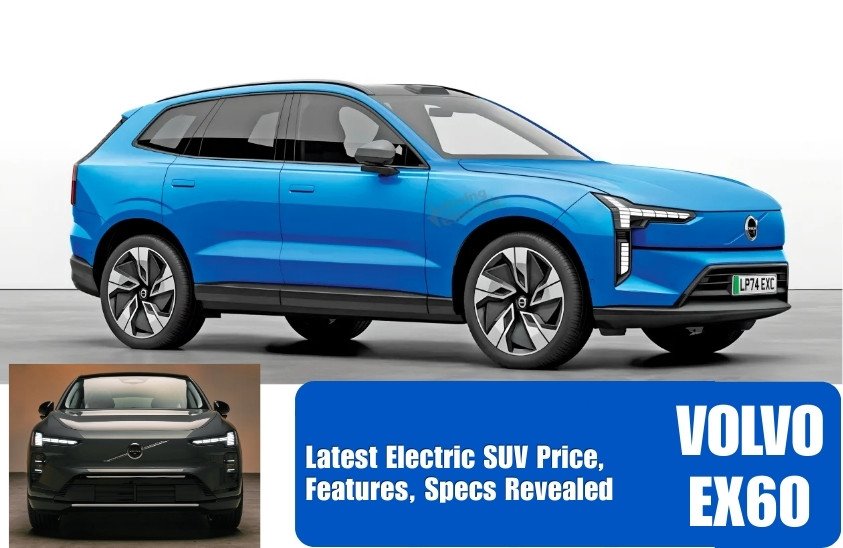
Volvo has just dropped what could have been the most significant vehicle in years. The Volvo EX60 electric SUV has been unveiled at the January 21, 2026, podcast in Stockholm and, frankly? The specifications are quite impressive. We are talking up to 400 miles of range, 670 horsepower in the highest trim, and an opening price of approximately 60,000.
I have followed the electric journey of Volvo closely, and this feels like it is not like their previous attempts with their EV. The EX30 faced major delays. EX90 had problems with software bugs. However, the EX60 seems to be the opportunity for Volvo to do everything correctly and even compete with the Tesla Model Y.
The current timing is what is of interest with this launch. BMW has recently unveiled the iX3, Mercedes is launching new electric SUVs, and the market for the same midsize luxury EV is being contested by all. The EX60 electric SUV unveiled by Volvo said it has range, specifications, and a price that have the potential to rattle.
The question is, what Volvo is offering and whether it is worth the wait.
What is the EX60 unlike other EVs at Volvo?
Built on an All-New Platform
The EX60 presents the SPA3 platform of Volvo, which is an enormous break from the previous one. In contrast to the EX90, which operates on SPA2, this new architecture was intended to serve electric cars at its inception.
What does that actually mean? The battery pack is not merely screwed into the floor – it is a part of the body itself. Volvo refers to it as cell-to-body, and it is the floor and structural part.
This strategy has a saving effect, space interior, and allegedly reduces expenses by approximately 25 percent at the pack level. Besides, it puts the battery 20% energy-dense compared with earlier generations.
Megacasting Makes Volvo Debut
Tesla made megacasting popular, and Volvo is now also not left out of the party. They are welding the huge castings of recycled aluminum as large single pieces instead of welding hundreds of smaller pieces of aluminum.
It is quicker to construct, cheaper to build, and possibly stiffer structurally. Whether it will be a long-term hold remains to be determined, but it is a clever step in manufacturing.
Power and Performance: 3 different variants
P6 Rear-Wheel Drive
Its entry-level P6 has one motor in the rear that produces 369 horsepower. That is enough to satisfy most of the people, and it accelerates to 60 mph in 5.7 seconds.
Depending on the choice of wheels, the range is approximately 310 miles. It is the cheapest and lightest model, which is suitable for drivers who do not require AWD and want maximum efficiency.
P10 AWD Mid-Range Option
Go to the P10 AWD, and you have two motors that have a combined horsepower of 503. All Wheel Drive is standard, and the 0-60 time reduces by 4.4 seconds.
Depending on the configuration range is between 300-320 miles. According to Volvo, this is going to be a volume seller at approximately 60k. It strikes that performance, range, and value sweet spot.
P12 AWD Performance King
It becomes wild with the range-topping P12 AWD. This version has 670 horsepower and acceleratesfrom 0 to 60 in only 3.8 seconds. That is a sports car in SUV form.
However, the best thing is this – although it has all the power, it still has a range of 375-400 miles due to its biggest battery pack in the line at 117 kWh usable capacity. In European WLTP trials, Volvo boasts of up to 503 miles, but EPA figures will be lower.
Billing the Speed Counts
800-Volt Architecture
The EX60 has an 800-volt electrical architecture, which is emerging as the standard of high-end EVs. This allows it to charge at a faster rate without heating the battery.
The EX60 increases its range by 173 miles in 10 minutes connected to a 400 kW fast charger. Under ideal conditions, the entire 10-80 percent charge will take approximately 18 minutes.
At the moment, there are no 400 kW chargers everywhere. However, 350 kW stations are becoming more widespread, with the EX60 still capable of charging at a stunningly slow rate on them.
First Volvo equipped with Native NACS Port.
This is one that U.S. buyers are going to care about; the EX60 will be the first Volvo to have a built-in Tesla-like charging port. No adapter to reach in excess of 25,000 Tesla Superchargers in North America.
That is massive in the real-world. The Tesla charging network remains the most accessible and extensive, thus native access eliminates a significant obstacle to EV ownership.
Smart Charging Technology
Including a thing known as Breathe Charge software that keeps track of battery status in real-time, included in Volvo. It gets to know about your charging habits and could charge rapidly as much as 30% faster, particularlying cold climates.
A 19.2 kWh onboard charger standard is available in the case of daily home charging. That is quicker than the base options of most competitors. The car is also bidirectionally charged, but this feature is unlikely to work now and will only become active through a software update in the future.
Interior Tech and Features
Google-Powered Infotainment
Its main feature is a curved 15.1-inch OLED touchscreen with Google automotive software. It comprises Google Maps, Google Assistant, and the Play Store applications.
It is clever that both Apple CarPlay and Android Auto are standard. People do not necessarily wish to be confined to a single ecosystem.
Volvo boasts that it is its most responsive infotainment system to date and employs such terms as no-lag and instant. We shall find out whether that stands the test of real-life practice, as the EX30- EX90 systems were painfully slow.
AI Assistant Integration
The EX60 comes with Google Gemini AI integration that is expected to make voice commands more natural and context sensitive. Instead of a strict command hierarchy, you can, in theory, have a real-life dialog with the car.
It is constructed upon the new HuginCore computing platform that is developed by Qualcomm, Google, and Nvidia. Darn good technology supporting the software.
Premium Audio Options
Two flagship options are extended to the audio enthusiasts. It has a 21-speaker Bose system or a 28-speaker Bowers and Wilkins system that features the first Volvo headrest-mounted speakers.
I wonder how those headrest speakers can work without separating the passengers from each other. May either be fantastic, or it may be a gimmick.
Safety Innovations
Multi-Adaptive Safety Belt
Introducing what they describe as the first multi-adaptive safety belt in the world, Volvo. Information is still developing, though it seems to vary in tension and positioning according to driving conditions and the number of occupants.
This might be more than marketing speak because Volvo has a reputation for being safety-conscious.
Lane Change Assist to Pilot.
Pilot Assist is also updated with lane change assistance, and thus, the car can work through a bit more of the highway driving load. It is not completely self-driving, but closer to being entirely highway-capable.
Demand a complete package of current-day safety features – forward collision warning and automatic emergency braking, blind spot monitoring, pedestrian detection, and surround-view cameras.
Family-Focused Features
The addition of two combined booster cushiontoto the second row by Volvo. These built-in seats can be modified to suit children without additional booster seats.
They also come with heating, a nice touch. Demonstrates that Volvo continues to consider families even in the technology-oriented EVs.
Pricing and Availability
U.S. Market Details
Volvo has not yet announced final pricing in the United States, but the P10 AWD will be about 60,000. The base P6 models must begin around $55,000, whereas the P12 AWD might approach $70, 000-75,000.
That would place it squarely in competition with the BMW iX3, Mercedes EQE SUV, and Audi Q6 E-tron. It is priced as affordable luxury as opposed to aspirational.
This spring will see the opening of orders in the U.S, and the P6 and P10 will take off in summer 2026. The P12 model is later in the year.
European Pricing
The EX60 begins at 62,990 euros in Germany, which is, in fact, even similar to the hybrid XC60. It is a clever pricing scheme to render the EV as affordable as conventional powertrains.
Delivery to Europe starts in summer 2026, and production will increase at the facility in Gothenburg, Sweden, for Volvo.
Cross Country Variant
An off-road Cross Country model is added to the range in 2028. It sits on a 0.8-inch higherplatform with the capacity to lift another 0.8 inches through air suspension.
Wider fender flares, stainless steel skid plates, exclusive wheels, and special color choices are expected. It will not reach the U.S. till summer 2027.
Competitiveness in comparison with others
EX60 is under intense competition. Model Y of Tesla continues to lead in terms of price, range, and charging network. German engineering comes with the BMW iX3. Mercedes is coming with the LC Electric.
In the territory of Volvo distinction, these are the safety heritage, Scandinavian design, and the range and charging speed. The 400-mile range is comparable to or exceeds most competitors, and 18-minute charging is truly best in the category.
Prices appear competitive as well. At mid-range AWD model of 60, 000, it is not cheap, but it is not too much either considering what you are getting.
Real-World Considerations
Will the Tech Work?
My biggest concern? Volvo has not had a smooth ride with its EV launches in the recent past. The EX30 faced massive delays. The launch of EX90 was accompanied by sluggish software and quality problems.
The EX60 is a clean-sheet architecture featuring a new platform and computing architecture. It has to be genius or life-threatening. There is much that can go awry.
Tariff Uncertainty
Volvo dealt with the possible American tariff on imported electric vehicles. They are manufactured in Sweden and brought to America, and this might be costly in case trade policy changes.
The company claims that they have nothing to worry about and there is no intention to shift into production. We will find out whether that confidence has been justified.
The China Question
Interestingly, Volvo is not introducing the EX60 in China at the beginning. It is unlike China, which has a massive EV market, but it is based on the strategy employed by sister brand Polestar.
It is likely prudent to concentrate on markets where they can charge premiums instead of competing with lower-priced domestic Chinese EVs.
Conclusion
The Volvo EX60 electric SUV was unveiled with a range, specifications, and a price that can truly compete withTesla’sa dominance. Volvo is also combating the key obstacles to EV adoption with 400 miles of range, an 18-minute charge, and an affordable price of about 60,000 dollars.
However, it is all about performance. Are they capable of doing so punctually without the delays that marred the EX30? Will the new software platform be trouble-free on day one? The answers to those questions will not be given until the arrival of customer cars in the summer of 2026.
The EX60 is worth paying attention to in case you are thinking of a midsize luxury electric SUV. The range, the speed of charging, the safety measures, and the Scandinavian design make something truly attractive.
Watch out in the first half of 2026, when configurators are expected, and you may want to make a reservation in case the specifications match your requirements. This may be the Volvo EV that gets it all right.
FAQs
A: Opening orders in spring 2026 to U.S. customers, and deliveries of the P6 and P10 in summer 2026. The high-performance P12 model comes later in the year. Summer 2026 also marks the beginning of European deliveries. The rugged Cross Country variant does not come to dealers until the 2028 model year, which will reach dealers in summer 2027.
A: Volvo is yet to declare its final U.S. prices, but the middle-range P10 AWD will go for around 60,000 dollars. The base P6 must be around $55000, and the highest P12 AWD models may go up to 70000-75000. In Europe, the price begins at 62,990 euros in Germany.
A: The P12 AWD has a range of 375-400 miles (EPA estimate), and European WLTP testing has a range of 503 miles. P10 AWD is capable of delivering 300-320 miles, and P6 gives approximately 310 miles. Real range depends on driving conditions, climate, and the type of wheel.
A: EX60 can charge a range of 173 miles in 10 minutes using a 400 kW DC fast charger or charge 10-80 percent in approximately 18 minutes. These speeds are made possible by the 800-volt architecture. In the home charging case, the 19.2 kWh inboard charger is quicker than most of the competitors.
A: EX60 has a greater reach (up to 400 miles against the 330 in Model Y), quicker charge time, and a rather luxurious interior. The Model Y is cheaper and has more Supercharger coverage, but the EX60 can now use native NACS-port connectivity. Performance is no different, and the EX60 P12 is more powerful than any variant on the Model Y.