The idea of Vehicle Scrappage Policy in India becomes clear when scrap value is understood first. Scrap value means the money received when old vehicles or unfit vehicles are sent for scrap instead of being repaired again. This value depends on the vehicle type, age, metal weight, and workable parts like tires.
The government funded program me supports vehicle owners by allowing them to replace outdated vehicles with modern vehicles and new vehicles on Indian roads. The primary goal is to create ecosystem support for phasing out polluting vehicles and lowering the carbon footprint of the country.
How Fitness Testing Decides Scrapping
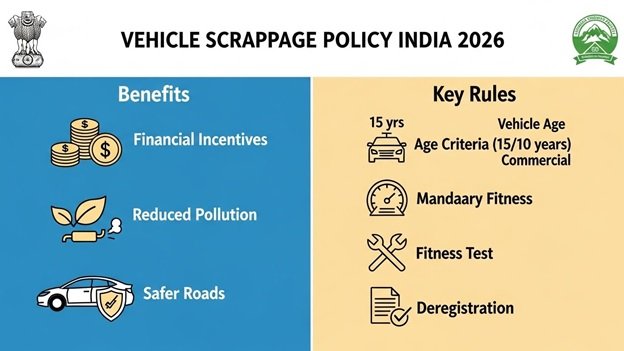
From April 1 2023, fitness testing for Heavy Commercial Vehicles, also called HCVs, happens only at Automated Testing Stations or ATSs. For Commercial Vehicles (CVs) and Private Vehicles (PVs), this rule applies from June 1 2024.
Vehicles older than 15 years and vehicles older than 20 years that fail fitness test are scrapped and are defined as ELV or End-of-Life Vehicle. This rule removes unsafe vehicles from roads and improves daily driving safety.
Why the Policy Became Important
The Indian automobile sector entered a troubled zone in the latter half of 2019. The COVID-19 pandemic made the situation worse.
The scrappage policy came as real help for the struggling automobile sector. When old vehicles phased out, fresh demand for replacements grows and also benefit environment.
Main Aim of Vehicle Scrappage Policy 2026
The aim of Vehicle Scrappage Policy 2026 stays very clear. The main objective is to identify old vehicles, polluting vehicles, and scrap them under a controlled system.
Key focus areas include:
- Reduce pollution from vehicles without valid fitness and registration
- Improve passenger safety, road safety, and vehicular safety
- Generate employment in the automobile industry
- Formalize informal vehicle scrappage industry
Economic and Industry Benefits
The new vehicle scrap policy supports the economy, the automobile sector, and others linked to transport. Less air pollution leads to better air quality across cities and towns.
More than 51 lakh light motor vehicles, including private vehicles and commercial vehicles, are more than 20 years old. Once replaced, the automobile sector benefit increases with fresh sales and job opportunities in vehicle scrapping centres, creating skilled manpower.
Incentives That Increase Scrap Value
Several incentives improve the final return when owners scrap old vehicles. These include:
- Avail discount of 4 to 6 percent discount on new vehicle cost (ex-showroom)
- No registration charges after declaring Certificate of Deposit
- Registration fees waived by authorities
- Concession on road tax offered by state governments
- Up to 25 percent for non-transport vehicles and 15 percent for transport vehicles
Extra discount on new vehicle of 5 percent may be offered by vehicle manufacturers, requested offer discount against the Certificate of Deposit, added over and above scrap value.
Where to Test or Scrap a Vehicle
Important points apply when registration due for renewal:
- Visit authorized Automated Testing Station to retain vehicle
- Go to nearest authorized scrapping facility to dispose vehicle
- Wait until ATSs operational, then access records through Parivahan database.
Strict RTO rules guide the car scrapping process. The vehicle owner must:
- Write letter to concerned RTO
- Submit affidavit stating no bank loan, insurance claims, pending traffic challans, or court cases
- Confirm vehicle not involved in thefts
- Surrender original documents
- Allow VIN plate to be cut out once car scrapped
The RTO hold documents and future reference includes scrap yard confirmation, facility letterhead, complete address, and pictures of the scrapped vehicle, all submitted to RTO.