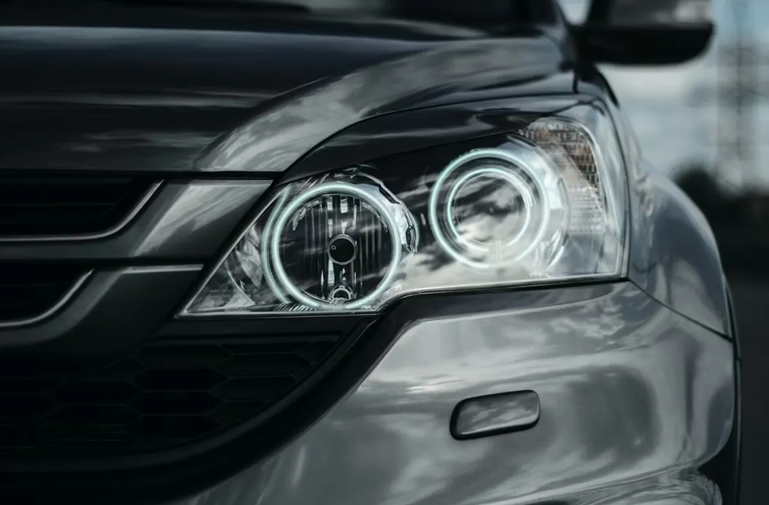
Your headlights function as critical safety gear rather than mere front-end styling, meaning your ability to see hazards—and be seen by others—relies entirely on them. If you want to know what the three basic types of car headlights are, the answer comes down to Halogen, HID (Xenon), and LED technologies.
Headlight Basics in Plain English
Before diving into the specific bulb technologies, you need to understand the structural components and metrics that determine how your car illuminates the road. Navigating aftermarket upgrades or dealer options is much easier once you know the terminology.
Bulb vs. Housing
The headlight assembly consists of two distinct parts. The bulb (or LED module) is the actual light source generating the illumination. The housing is the large plastic or glass enclosure mounted to your vehicle that contains the optical components. You can install the brightest bulb on the market, but if your housing optics are degraded or poorly designed, your visibility will remain subpar.
Low Beam vs. High Beam
Your vehicle uses two primary lighting modes. Low beams are designed with a strict horizontal cutoff line to keep the light focused on the pavement and out of the eyes of oncoming traffic. High beams remove this restriction, throwing the maximum amount of light as far down the road as possible. You use high beams for rural, unlit roads where glare is not an issue for other drivers.
Beam Pattern Essentials
A safe and effective beam pattern requires three elements: a cutoff, a hotspot, and a spread.
- Cutoff: The sharp line at the top of the low beam pattern. Light below the line hits the road; above the line is darkness.
- Hotspot: The most intense concentration of light, positioned just below the cutoff in the center of your lane to maximize your forward distance vision.
- Spread: The width of the beam. A good spread illuminates the shoulders of the road, helping you spot wildlife or pedestrians.
When a bulb is mismatched with a housing, it destroys this pattern and creates scattered light. This scattered light causes dangerous glare for oncoming drivers and reduces your own visibility.
Brightness vs. Color
Manufacturers measure raw brightness output in lumens. However, brightness does not tell the whole story. Color temperature, measured in Kelvin (K), dictates the tint of the light. According to automotive lighting standards, daylight falls around the 5000K to 5500K mark. This is why 4300K to 6000K is the most common range for road use; it mimics natural daylight, which maximizes contrast and allows the human eye to process details rapidly.
The Three Core Car Headlight Types
When you replace a burnt-out light or upgrade your vehicle, you will encounter three primary bulb technologies. Here is how they operate, along with their distinct advantages and drawbacks.
1. Halogen Headlights
Halogen bulbs have been the automotive industry standard for decades.
- How it works: They operate similarly to classic incandescent bulbs. A tungsten filament is enclosed in a glass envelope filled with halogen gas. When electricity passes through the filament, it heats up and glows. The halogen gas prevents the tungsten from degrading too quickly.
- Pros: They are the cheapest option on the market. They are extremely easy to replace, and you can find them at any auto parts store or gas station.
- Cons: Halogens are the least bright of the three types. They emit a yellowish, warm color. They also have a shorter lifespan and draw a significant amount of power because they waste most of their energy generating heat rather than light.
- Best for: Drivers on tight budgets, older vehicles designed specifically for halogen output, and drivers who primarily commute in well-lit urban environments.
2. HID / Xenon Headlights
High-Intensity Discharge (HID) headlights, often called Xenon headlights, introduced a massive leap in nighttime visibility when they debuted in the late 1990s.
- How it works: Unlike halogens, HIDs do not have a filament. Instead, they create an electric arc between two electrodes inside a quartz tube filled with xenon gas. This system requires an external module called a ballast to ignite the arc with high voltage and then regulate the current. They require a brief warm-up period of a few seconds to reach full brightness.
- Pros: HIDs are exceptionally bright, highly efficient, and offer incredible forward reach down the road.
- Cons: They are pricier to replace due to the complex bulbs and ballasts. If installed in the wrong type of housing, they create severe, blinding glare.
- Best for: Highway and rural night driving. They must be used in projector housings to control their intense output properly.
3. LED Headlights
Light-Emitting Diodes (LEDs) represent the current standard for modern automotive lighting.
- How it works: LEDs pass an electrical current through a microchip (the diode), which illuminates. Because LEDs are highly sensitive to operating temperatures, they require built-in electronic drivers to control voltage and physical heat sinks (or cooling fans) to pull heat away from the diode.
- Pros: They are incredibly efficient, requiring very little power. They offer instant-on illumination with no warm-up time. They boast an exceptionally long lifespan. Furthermore, the compact size of LED modules allows car manufacturers to create advanced, adaptive headlight shapes.
- Cons: They carry a higher upfront cost. The complex cooling mechanisms can fail if poorly manufactured. Quality varies drastically between different aftermarket brands.
- Best for: Modern vehicles and drivers who want precise beam control combined with a low electrical draw. Many people opt for aftermarket LED headlight bulbs for a direct, high-performance upgrade over their factory halogens.
- Many drivers choose to upgrade their halogen bulbs to LED headlight bulbs for better brightness.
Halogen vs HID vs LED: Cost, Lifespan, and Efficiency
Making an informed decision requires looking past the initial purchase price and considering the total cost of ownership.
- Halogen: These are low cost upfront, usually under $30 a pair. However, they only last between 450 and 1000 hours. They are highly inefficient, drawing around 55W per bulb.
- HID: These sit in the mid-to-high cost bracket, often ranging from $50 to over $150 a pair depending on the brand. They last significantly longer, typically offering 2000+ hours of life. They are more efficient than halogens, usually drawing around 35W per bulb (plus the ballast operation).
- LED: These have the highest upfront cost for quality units, often exceeding $100 a pair. However, they boast a lifespan of 10,000 to 30,000 hours depending on the module’s thermal management. They are the most efficient, drawing an equivalent of 15 to 30W.
Over the lifespan of a single LED bulb, you might have to purchase and install ten sets of halogen bulbs. The fewer replacements and lower power draw often offset the higher initial purchase price of LEDs.
Housings and Optics: Reflector vs Projector
The technology inside the bulb only dictates the raw light output. How that light hits the road depends entirely on your headlight housing.
Reflector Housings
Reflector housings feature a mirrored, parabolic bowl behind the bulb. The bulb shines backward and sideways into this bowl, which bounces the light forward onto the road.
- Pros: They are mechanically simple, lightweight, and low-cost to manufacture. They are the most common pairing for standard halogen bulbs.
- Cons: They are less precise. The beam pattern is softer, making it harder to control glare. Installing high-output HID or LED bulbs into standard reflector housings often results in hazardous glare for other drivers.
Projector Housings
Projector housings look like a glass sphere or eye. The bulb sits behind a curved shield and a thick magnifying lens.
- Pros: The internal metal shutter creates a razor-sharp cutoff line. This crisp beam pattern is ideal for handling the intense light output of HID and LED sources, offering superior glare control.
- Cons: They are costlier to produce. They require precise mechanical alignment and high-quality internal components to function correctly.
Kinds of Headlight Color
The color temperature of your headlights drastically impacts how well you see in different weather conditions.
- Yellow (3000K): Yellow light wavelengths cut through airborne moisture efficiently. This color minimizes the “wall of light” back-glare you experience in heavy fog, rain, or snow. For this reason, yellow is the ideal color for auxiliary fog lights.
- White (4300K – 5500K): Pure white is the optimal zone for forward headlights. It perfectly balances high contrast and depth perception, allowing your eyes to easily identify road signs, debris, and lane markings without unnecessary strain.
- Blue (6000K+): While bulbs pushing a blue tint look highly modern and aggressive, they actually perform poorly. The human eye struggles to process blue light efficiently in the dark. Blue light also scatters heavily in rain and fog, reducing your visible range.
What Kind of Headlight Bulb Do I Need?
Choosing between a halogen bulb, an HID, or an LED depends on your vehicle’s hardware and your driving environment.
If you drive an older vehicle equipped with standard reflector housings and you primarily stick to well-lit city streets, sticking with high-quality halogen bulbs is the most practical and cost-effective choice.
If you frequently navigate dark, rural roads where distance vision is paramount, and your vehicle is equipped with projector housings, an HID system provides unparalleled forward reach and intensity.
If you are looking for a massive lifespan, instant brightness, and a clean white output that reduces the strain on your vehicle’s electrical system, an LED upgrade is the way to go. Just ensure you purchase a reputable aftermarket LED brand like SEALIGHT LED that features proper heat sinks to guarantee their longevity.