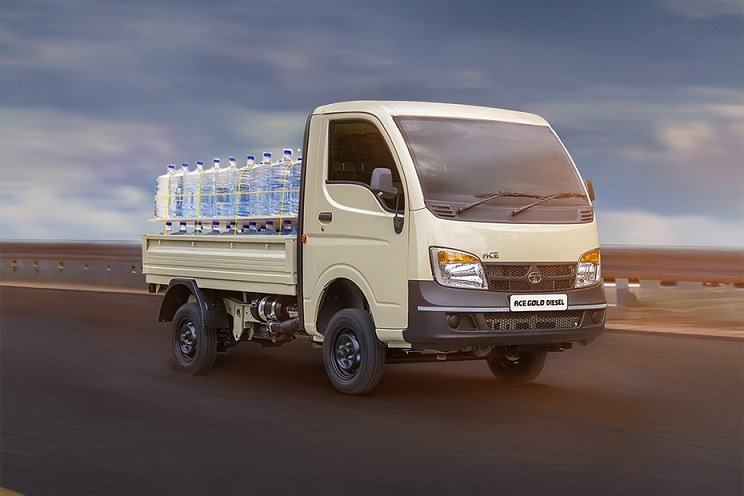
A few years back when the Tata Motors introduced the Ace in 2005, it did not merely introduce the new commercial vehicle into the Indian market but also has re-drawn the map of the small-scale transportation in India.
The Tata Ace was designed to address an actual need, the lack of a cheap, manoeuvrable, four-wheeler to replace overloaded three-wheelers and hand-pulled carts, which required a long period of field research as engineered by Girish Wagh, who actually interviewed small transporters around the nation.
More than 24 lakh entrepreneurs have been enabled by the Tata Ace, it has acquired a sweet India nickname of Chhota Hathi (Little Elephant) and the small commercial vehicle segment leader over 20 years in the Indian market continues to be unchallenged by any other product or service. Its small size, multi-fuel capacity, high carrying capacity, and low maintenance charges ever since make it the initial choice of vehicle by both the owner-operators and fleet companies.
Price
Tata Ace family is priced in such a way that it is affordable to a broad market of buyers. Ace Gold Petrol CX is the lowest priced car costing around Rs4.15 lakh (ex showroom) and thus is among the most affordable mini trucks in the country.
The Tata Ace Gold Petrol LX has a price range of Rs4.62 lakh to Rs5.08 lakh with the CNG starting at approximately Rs5.01 lakh. The bi-fuel CNG+ option that is capable of operating on both CNG and petrol begins at around Rs5.67 lakh.
The Ace Gold diesel will be available at a cost of Rs6.01 lakh to Rs6.60 lakh to buyers who use diesel.
Upwards the more powerful, Ace HT+ diesel turbocharged begins at Rs7.19 lakh in Delhi. The electric models will be positioned at the high-end side of the Ace range with the Ace EV retailing between Rs10.20 lakh and the Ace EV 1000 costing between Rs11.27 lakh and Rs11.40 lakh.
The prices in the on-road are set differently in different states as the road tax systems and other registration fees are different.
Variants
By 2026, the Indian market already had 13 different versions of Tata Ace in the four types of fuel. The Ace Gold is at the centre of the range and is available in four fuel options that are: Petrol, CNG, CNG+, and Diesel.
The basic model is the Ace Gold CX and the higher trim is the LX, a premium petrol model, which has a higher payload rating.
The Ace Gold Diesel introduces a dual driving mode system – a Power Mode with 22 hp and 55 Nm, and a City Mode with 17 hp and 40 Nm – that allows drivers to choose how to perform or how to save fuel by the traffic situation.
There is the Ace HT+ above the Gold range, which comes with a 798 cc 2-cylinder inter-cooled DICOR-powered engine with 35 hp and 85 Nm of power but with a payload capacity of 1,100 kg and a longer 2,520 mm load body, more appropriate to companies that need to carry heavier and/or bulkier loads.
The Ace EV and Ace EV 1000 will meet the increasing demand of more environmentally friendly, last-mile delivery and Tata asserts that the EV 1000 is the first electric mini truck in India to carry a payload capacity of 1,000 kg.
Specifications
- Ace Gold Petrol has a 694 cc, 2 cylinder and 4 stroke, water-cooled, MPFI BS6 engine.
- The CX trim generates 25 hp and 55 Nm whereas LX trim generates 30 hp at 4000 rpm with the same 55 Nm torque.
- The CNG version is powered by the same 694 cc block with a gas injection tune, and has an output of 26 hp at 4,000 rpm and 51 Nm between 2,000 and 2,500 rpm.
- A 2-cylinder compression ignition engine with 702 ccs is used to operate the Diesel version.
- Every variation comes with a 5-speed manual gearbox with a single-plate dry friction diaphragm clutch.
- The payload varies between 750kg on the CX Petrol up to 900kg on the Diesel and better Gold models with the Gross Vehicle weight of 1,835kg on full loaded models.
- The wheelbase remains the same with 2,100 mm throughout the Gold line.
- The petrol and diesel models have a fuel tank capacity of 26 litres and the CNG+ models have an extra CNG cylinder.
- The alleged mileage of petrol and diesel models is 21 to 22km /l, whereas the Ace EV 1000 has 161km certified on a single charge of its 21.3 kWh lithium iron phosphate battery.
- Clearance at the ground level is 160 mm and the maximum speed is 65 to 70 kmph -suitable to the city and semi-urban delivery routes.
Colours
Tata Ace gold model comes in two colours.
- The Ace brand signature colour is Sunshine Yellow which has come to be associated with the Ace brand in India and is the most ubiquitous colour on Indian city roads, delivery routes and market places.
- The second choice would be white, which is favored by fleet operators and business owners who do not mind applying a custom brand or company livery on the load body.
- Although the colour palette is relatively lower than passenger cars, it has purpose since the vehicle is a commercial one, and it is also meant to be used functionally in various weather conditions and not as a work of art.
Interior
The cabin in the Ace Gold is designed to fit into the day-to-day reality of a commercial operator. It is not made with luxury in mind, and when a working driver needs to spend long hours on the road it provides the specifics of what he or she requires.
At the centre of the dashboard is a digital instrument cluster showing average fuel economy statistics, a driver message screen, and warning indicators all necessary to a driver running a small business. A steering wheel which is designed ergonomically is better to handle and to reduce fatigue on the longer routes and certain higher variants also have tilt and telescopic steering options that a driver of varying height can operate.
The cabin has a sizeable lockable glovebox to keep delivery papers and other valuables in a safe place, a bottle holder and a document holder. It has a USB smartphone charging port as an option, just in recognition of the fact that a modern driver needs a charged phone to carry out navigation and business communication. The cabin has one co-passenger and one driver on a bench.
The cabin is also made of all-steel which gives the cabin structural strength and some level of protection that cannot be provided by the plastic heavy cabins. Remarkably, the Ace Gold lacks air conditioning or an installed music system, and this helps to contain weight and cost, which is a conscious choice based on the commercial use of the vehicle.
Safety Features
On a vehicle that will have the main use in congested city areas, where it will likely be oriented on narrow lanes, crowded intersections, and unbalanced roads when fully loaded, the Tata Ace Gold is fitted with an excellent set of safety engineering decisions.
The braking system is a combination of front disc brakes and rear drum brakes that have diameters of 200mm and widths of 30mm respectively and this gives the braking performance controlled even when under load. It has a standard parking brake included in all variants.
Parabolic leaf springs are fitted at the front and semi-elliptical leaf springs at the rear, which is a compromise between ride quality and carrying load ability.
The ground clearance of 160 mm is enough to overcome the potholes, speed breakers, and debris that are a common occurrence on the roads of the Indian urban areas without affecting the centre of gravity of the vehicle.
Diesel model has a 27.5% grade-ability which means that it can safely climb steep flyovers and inclined roads full loaded.
The mechanical variable ratio steering system permits the control to be very precise in tight spaces without using power steering support. The chassis itself is a heavy-duty framework that offers a stable drive and prevents torsional movement when under load, which offers a confidence-inducing drive on every working day.
Benefits
- The biggest strength of the Tata Ace is the total value proposition. Beginning with the economics of fuel, petrol and CNG versions reported 21 to 22 kmpl, and the Ace EV 1000 achieves about Rs1 per km, which directly translate to more net profit by owner-operators.
- This multi-fuel option implies that a customer in Delhi-NCR can make a cheaper choice and switch to the CNG+ to achieve the lowest price per-km fuel price, whereas a customer in a smaller city with limited CNG coverage can switch to petrol or diesel without losing anything.
- The low payload to price ratio 900 kg at less than 5 lakh is unrivalled in its category. Its small size with a turning radius that fits into tight market lanes and residential streets has allowed the Ace to penetrate places where a larger truck cannot penetrate.
- Another characteristic advantage is low maintenance: the simple, time-tested 2-cylinder engines have limited failure points, parts are universally compatible in the vast pan-India dealer network Tata has, and the 3-year warranty or 1 lakh km warranty (2 years or 72000 km on some models) gives financial security.
- The high resale price that the vehicle commands in the used-truck market only increases its economic worth, and thus it is not only a tool of the business, but an investment. The Ace is permitted to transport a broad variety of cargo, including fruits and vegetables, milk cans, and LPG cylinders, e-commerce parcels, FMCG goods, and cement bags, which implies that one truck can be used in the business in various verticals throughout its service life.
Verdict
Twenty years since it was first dispatched out of the Tata Motors Pune plant, Tata Ace still makes ends meet on the streets of all Indian cities, towns as well as semi-urban corridors. The fact that it has developed as a single petrol model into a 13-model family with petrol, CNG, diesel, and electric powertrains, shows how much Tata Motors has heard the voice of its small entrepreneur customer who regards a vehicle as a way of making a living. The Tata Ace is the ultimate small commercial vehicle of the modern India, whether in terms of unit sales, allegiance of its operators or payback.
Refresh Date: March 20, 2026