Introduction: The Central Role of Workbenches in Precision Work Areas
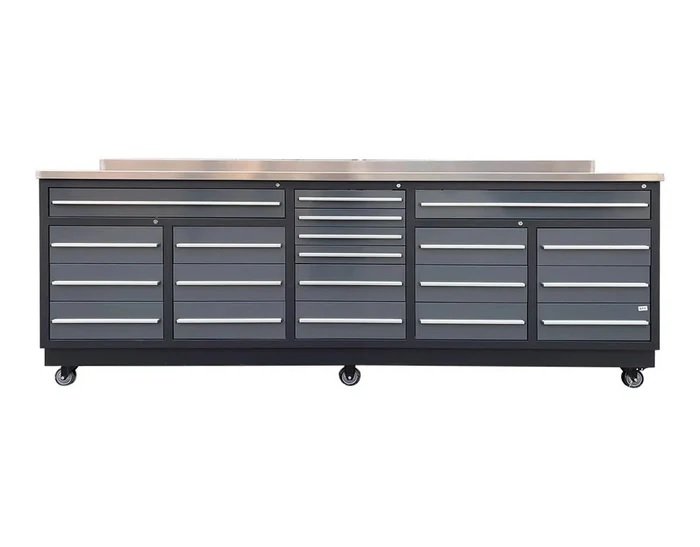
In Australian industrial maintenance, assembly, and testing environments, the quality of work surfaces directly influences task precision, efficiency, and safety. For tasks involving sensitive components, clean assembly, or tools requiring systematic organisation, a standard workbench may be insufficient. A 2.8m workbench with a stainless steel benchtop and integrated storage is designed to meet these demands, providing a durable, cleanable surface and secure tool organisation as a foundational element of a professional workshop.
Technical Overview: Design and Key Features
This category of industrial workbench is defined by its materials and integrated storage. The 2.8m (approximately 9-foot) stainless steel benchtop offers high durability, chemical resistance, and easy cleaning. The inclusion of 20 lockable stainless steel drawers, typically on full-extension slides, provides significant secure storage capacity directly at the work point. This design consolidates workspace and organised storage into a single, robust unit.
Operational Priorities: Organisation, Contamination Control, and Security
Implementing this type of workstation supports several specific operational goals:
- Enhanced Tool Control: Dedicated drawers secure high-value, calibrated, or specialised tools, reducing loss and misplacement.
- Workspace Hygiene: The non-porous, stainless steel surface is ideal for tasks requiring cleanliness and is easily sanitised, important in food processing, pharmaceutical, or electronics repair contexts.
- Workflow Efficiency: Having all necessary tools and parts stored systematically within arm’s reach minimises unnecessary movement and task interruption.
Key Selection Criteria for Specialised ApplicationsMaterial Suitability
The stainless steel top must be selected for its grade and finish suitability for the intended tasks, whether involving oils, chemicals, or requiring a sterile work area.
Storage Configuration and Security
The number, size, and layout of the 20 drawers must align with the inventory of tools and parts they are meant to hold. The quality of locking mechanisms is critical for asset security.
Structural Capacity and Workspace Layout
The bench must support the intended static and dynamic loads. The 2.8m length requires adequate floor space and consideration for user access from multiple sides.
Factors Influencing Long-Term Performance
The ongoing functionality and safety of the workbench depend on several factors:
- Load management within drawers to prevent overloading and damage to slide mechanisms.
- Regular cleaning of the stainless surface with appropriate agents to prevent corrosion or staining.
- Secure installation on a level floor to ensure stability, especially when drawers are fully extended.
Safety Considerations and Best PracticesLoad Distribution and Drawer Use
Heavy items should be stored in lower drawers. Avoid opening multiple heavy-laden drawers simultaneously to prevent tipping. Use drawer locks during transit if the bench is mobile.
Workspace Organisation
Keep the benchtop clear of obstructions when not in use. Ensure drawers are fully closed when not being accessed to prevent trip hazards.
Material Handling
Use care when placing sharp or heavy objects on the stainless surface to avoid scratches or dents that can compromise cleanability.
Associated Workshop Integration
This workbench often serves as a primary station in a workshop. It may be complemented by overhead lighting, power strips mounted along the back, and adjacent shelving for bulkier items not stored in the drawers.
Advantages and Practical LimitationsPrimary Advantages
- Superior durability and hygiene compared to wood or painted steel tops.
- Massive, secure, and organised storage capacity integrated into the workspace.
- Professional appearance and functionality suitable for regulated or high-precision industries.
Key Limitations
- Higher initial investment compared to basic workbenches.
- Stainless steel surfaces can show scratches and may be prone to glare under certain lighting.
- The substantial size and weight make relocation or repositioning difficult.
Practical Application: A Mining Equipment Service Workshop
A service centre in Queensland for hydraulic mining components implemented several of these workbenches. Each bench is assigned to a specific system (e.g., pump overhaul, valve testing). The stainless top allows for easy cleanup of hydraulic fluid, and the 20 drawers organise the myriad of seals, O-rings, and specialised tools for each system. This setup has reduced cross-contamination of parts, improved technician efficiency, and provided auditable security for calibrated tools.
Conclusion: Strategic Investment for Specialised Workshop Functions
A 2.8m stainless steel workbench with comprehensive drawer storage represents a strategic capital investment for workshops where organisation, cleanliness, and tool security are paramount. It addresses multiple challenges—contamination control, tool accountability, and workspace efficiency—in one integrated solution. The trend in Australian advanced manufacturing and maintenance is toward creating dedicated, optimised work cells. Specifying workstations with the appropriate material and storage properties is a critical step in building a workshop infrastructure that supports quality, safety, and productivity goals for the long term.