Public conversations about electric vehicles usually begin with range, charging speed, or acceleration scores. Inside engineering labs and regulatory offices, however, the focus shifts to something far more fundamental: how well a battery survives mechanical abuse.
Lithium-ion batteries offer exceptional energy density, but that efficiency comes with sensitivity to physical and thermal stress. On real roads, vehicles experience impacts, chassis deformation, flying debris, and unpredictable loads. To ensure that these events never escalate into thermal runaway, engineers rely on destructive safety tests designed to push batteries beyond their limits.
Among multiple global standards—IEC 62133, UL 2580, UN 38.3—two tests consistently stand out due to their severity and importance: Crush Testing and Nail Penetration Testing. These tests recreate the most extreme scenarios to verify that a battery pack will not turn a crash into a fire.
Starting With Thermal Runaway: The Real Threat
Both crush and nail penetration tests serve a single purpose: preventing thermal runaway.
Inside each cell, a thin separator keeps the positive and negative electrodes apart. If the separator is damaged—whether by compressive force or a sharp intrusion—the electrodes can short-circuit. This short generates localized heat. If the heat rises faster than it can be dissipated, the cell enters a chain reaction involving electrolyte decomposition, gas release, and, in worst cases, fire or explosion.
Mechanical-abuse testing evaluates whether a battery can withstand severe physical damage without triggering this chain reaction, or at least delay it long enough for occupants to escape safely.
Crush Testing: Recreating a Side-Impact Collision
Side-impact crashes create intense compressive forces on the vehicle’s floor structure, where most EV packs are located. The Crush Test is engineered to reproduce that moment.
In a controlled environment, a hydraulic ram presses a flat plate or semi-cylindrical fixture into a battery module or pack. Depending on the standard and vehicle size, applied forces can range from 13 kN to over 100 kN. The test continues until a defined pressure level or deformation threshold is reached.
Engineers monitor several key indicators:
- Structural integrity: Does the casing crack or leak electrolyte?
- Electrical behavior: Sudden voltage drop may signal an internal short.
- Thermal propagation: If one cell fails, does the event stay contained?
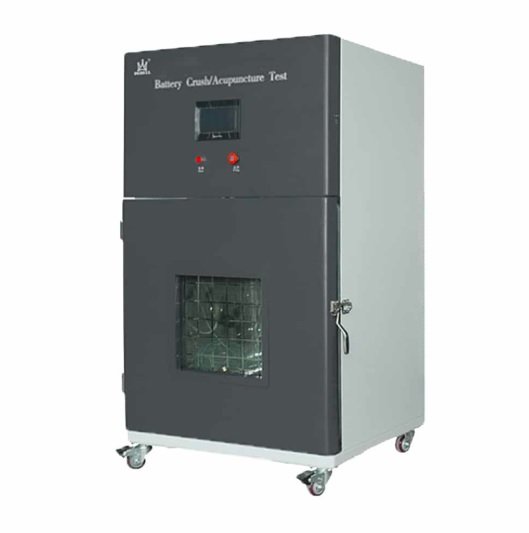
To run these tests safely, labs utilize a specialized battery crush nail penetration tester. These chambers typically include:
- Explosion-proof observation windows
- Smoke and gas extraction systems
- Fire suppression units
- High-speed force, displacement, voltage, and temperature acquisition
Together, these tools help pinpoint the moment and mechanism of failure, shaping improvements in battery enclosure design and safety engineering.
Nail Penetration Testing: The Most Extreme Internal Short
If crush testing simulates blunt trauma, the nail penetration test replicates a precise and catastrophic intrusion—like metal debris puncturing the battery from below. It is one of the harshest tests for any lithium-ion cell.
During testing, a steel nail (typically 3–8 mm in diameter) is driven straight into a fully charged cell. Unlike crush testing, which may cause internal shorting, nail penetration almost guarantees it. The nail directly bridges the electrodes, forcing the cell to confront an extreme short-circuit event.
This test is both controversial and indispensable:
- It exposes weaknesses in separator design and electrode configuration.
- It evaluates heat generation and gas release during worst-case failure.
- It highlights differences between chemistries such as NMC and LFP.
Early-generation cells often ignited violently during needle penetration. Modern cells, especially those using LFP chemistry or ceramic-coated separators, frequently show milder responses—such as venting or smoke—without open flame. These industry-wide improvements are the direct result of rigorous, repeated abuse testing.
Environmental Chambers: Because Real Accidents Aren’t at 25°C
Accidents seldom occur under ideal laboratory temperatures. A battery that behaves safely at 25°C can become brittle at –20°C or unstable at 60°C. For this reason, mechanical tests are often combined with temperature conditioning.
Advanced automotive R&D facilities now integrate mechanical abuse, electrical cycling, and thermal stress into unified test workflows. Leading environmental test chamber manufacturers like DGBELL provide systems that combine:
- High/low temperature control
- Vibration
- Crush and penetration fixtures
- Charge/discharge cycling
This holistic approach yields safer, more realistic data and better reflects the unpredictable environments in which EVs operate.
Safety Is Engineered—Never Assumed
As EVs continue pushing toward higher energy density and ultra-fast charging, the margin for failure becomes smaller. Whether future EVs run on NMC, LFP, or emerging solid-state chemistries, their safety depends on the rigorous testing being done today.
Crush and nail penetration tests are intentionally destructive. Every smoking, venting, or burning prototype inside a test chamber represents a risk identified before reaching consumers. These unseen evaluations ensure that the battery beneath the cabin floor isn’t just powerful—but proven safe under the harshest imaginable conditions.