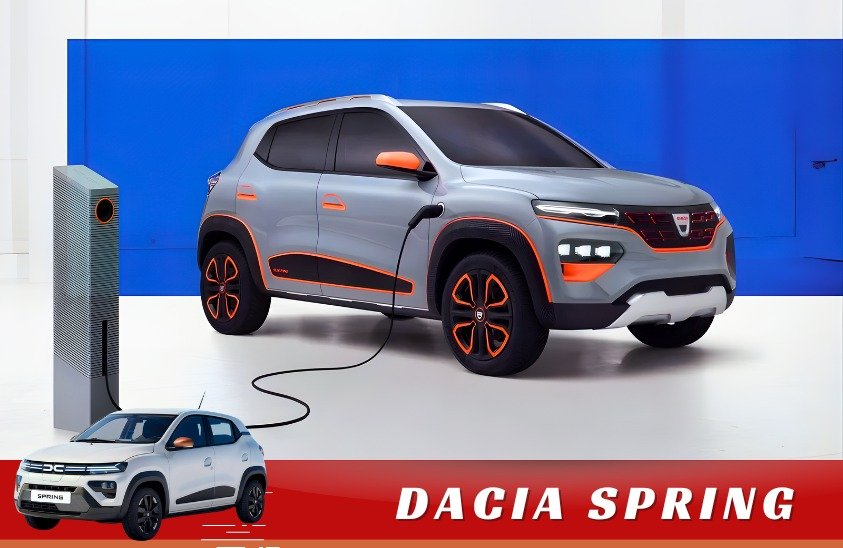
As electric cars become more popular in India, budget-friendly EVs are gaining strong attention from buyers looking for a practical city vehicle. In this growing space, the Dacia Spring 2026 stands out as one of the most affordable electric cars globally. The Dacia spring is an economically minded electric urban car that has altered the perception people have of affordable EVs. It is primarily an urban commuter design aimed at having low purchase price, easy engineering, and extremely low operating costs. The Spring aims to focused on the first-time buyers of EVs, small families, and urban users that require a practical, compact, and economic vehicle.
This article will provide you complete information about Dacia Spring, it’s company overview, key features & price details.
Dacia Spring: Company Overview
Dacia is a Romanian motorcar brand that is recognized to manufacture affordable and durable cars. It has been working in the area of value-based engineering instead of luxury since 1999 when it became a subsidiary of Renault. The brand has gained a strong reputation in Europe through the positioning of cars that fulfil basic requirements at the lowest possible price.
The first electric vehicle of the company is the Dacia Spring, which was released in 2021. It is grounded in the Renault K-ZE platform and is produced in China through Renault international coalition. The Spring is a symbol of the philosophy of Dacia, but in the form of an electric car cut out redundant elements, ownership cost will be minimal, and provide reliable urban mobility.
| Aspect | Details |
| Model Name | Dacia Spring (Electric) |
| Brand | Automobile Dacia |
| Parent Company | Renault Group |
| Country of Brand Origin | Romania |
| Vehicle Type | A-segment / City Electric Vehicle (EV) |
| Powertrain | 100% Electric |
| Platform | CMF-A (Common Module Family – A) |
| Production Start | 2021 |
| Manufacturing Location | China (for European markets) |
| Seating Capacity | 4 passengers |
| Body Style | 5-door hatchback / compact crossover styling |
| Battery Capacity | Approx. 26.8 kWh (varies by version) |
| Electric Range | ~230 km (WLTP combined), ~305 km (urban cycle) |
| Charging Support | AC charging standard; DC fast charging available in select variants |
| Market Positioning | Budget / entry-level electric car |
| Primary Markets | Europe (sold under Dacia brand) |
| Key USP | One of the most affordable electric cars in Europe |
Dacia Spring Price (Ex-Showroom and On-Road)and Variants
The Dacia Spring 2026 will be offered internationally in two variants: Expression Electric 70 and Extreme Electric 100. In the UK, prices start at £12,240, which roughly translates to an estimated ₹8–14 lakh ex-showroom in India. The car is expected to arrive in India as the Renault Kwid EV, with a possible launch around 2025–26.
The Expression Electric 70 is the base variant with a 70 hp motor and essential features like a 7-inch touchscreen, manual AC, and alloy wheels. Its estimated India ex-showroom price is around ₹8 lakh, leading to an expected Delhi on-road price of about ₹9.5 lakh after taxes and insurance. The Extreme Electric 100 is the top variant, offering a more powerful 100 hp motor along with a larger 10.1-inch touchscreen, wireless Android Auto/Apple CarPlay, rear camera, and V2L support.
This version could be priced at ₹10–11 lakh ex-showroom, with an estimated Delhi on-road price of ₹12.5–13.5 lakh. Since the model is yet to be officially launched in India, all prices remain indicative. Final pricing will depend on localisation, state taxes, and possible FAME-III subsidies, which could reduce costs by ₹50,000 to ₹1 lakh.
| Variant | Power | UK On-Road Price | India Ex-Showroom (Est.) | Road Tax (Delhi ~13%) | Insurance | Delhi On-Road (Est.) |
| Expression Electric 70 | 70 hp | £12,240 | ₹8.0 lakh | ₹1.04 lakh | ₹0.30 lakh | ₹9.5 lakh |
| Extreme Electric 100 | 100 hp | £13,240 | ₹10.5 lakh | ₹1.37 lakh | ₹0.35 lakh | ₹12.5 lakh |
Notes (Important)
- Prices are speculative; no official India launch yet.
- Expected India debut: 2025–26, rebadged as Renault Kwid EV.
- Delhi on-road includes road tax + registration (~₹5k) + FASTag & misc. (~₹10–15k).
- FAME-III subsidy (if applicable) may reduce prices by ₹50,000–₹1 lakh.
- Mumbai/Bengaluru on-road prices may be ₹0.5–1 lakh higher due to state taxes.
- Grey imports (CBU) will be significantly costlier.
Dacia Spring On Road Price (City Wise)
Even though India does not have the official pricing, the approximated on-road price can differ based on the state road tax, insurance, and EV subsidies. EV cities that are friendly to EVs might have a lower ownership cost.
| City | Expression Variant | Extreme Variant |
| Delhi | ₹11.5–12.2 lakh | ₹12.8–13.4 lakh |
| Mumbai | ₹12.0–13.0 lakh | ₹13.2–14.0 lakh |
| Bengaluru | ₹11.8–12.8 lakh | ₹13.0–13.8 lakh |
| Chennai | ₹11.6–12.5 lakh | ₹12.9–13.6 lakh |
Dacia Spring Top Speed, Engine & Performance
Dacia Spring has one front-mounted electric motor and a small battery. It is also available in two power outputs to accommodate the various buyers. The standard model is based on efficiency, whereas the Extreme model has better acceleration to run in the city.
| Specification | Details |
| Motor Type | Single electric motor (FWD) |
| Power Options | 65 hp / 100 hp |
| 0–60 km/h | ~5.8 seconds (100 hp) |
| Top Speed | 125 km/h |
| Driving Focus | City & suburban use |
Mileage & Fuel Economy
The Dacia Spring does not use fuel since it is a fully electric car. Rather, the efficiency is a kilometer per kilowatt-hour. Its small battery is made to be lightweight and urban efficient and not long distance.
Under the conditions of a real city in India, the Spring can easily cope with the everyday commuting with minimum expenses on charging, so it becomes one of the lowest-cost cars to operate in terms of costs per kilometer.
| Parameter | Value |
| Battery Capacity | 26.8 kWh |
| WLTP Range | ~225 km |
| Real-World City Range | 180–200 km |
| Efficiency | 4–5 km/kWh |
| AC Charging Time | ~6 hours (7 kW) |
| DC Fast Charging | 80 km in ~30 minutes |
Off-Road Hardware & Capability
Although seemingly a crossover vehicle, the Dacia Spring is an urban car. It does not have sophisticated off road features like all wheel drive or terrain mode. Its suspension is however tuned to accommodate broken city roads and speed breakers fairly well.
When applied to Indian conditions it is capable of coping with potholes and uneven tarmac though it must not be used on rough rural roads or trails.
| Feature | Availability |
| Ground Clearance | ~150 mm |
| Drive Type | Front-wheel drive |
| AWD / 4×4 | No |
| Terrain Modes | No |
| Best Use Case | City roads |
Dacia Spring Interior Features
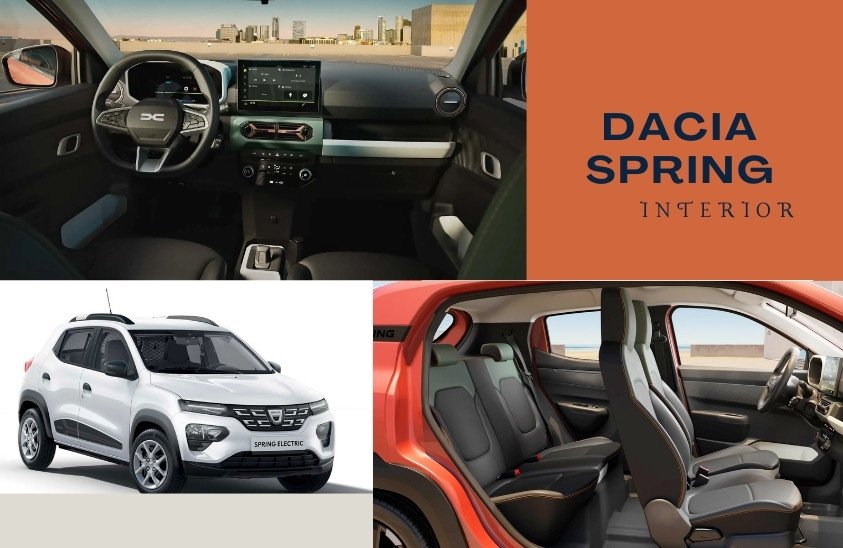
The Dacia spring interior is also basic, functional and economical. The cabin consists of hard plastics, but the design is convenient and easy to use. The vehicle has four adult seats and accommodates reasonably well headroom given the size of the car. One of the strongest aspects of the Spring is boot space, which will be convenient during the day and quick trips. Premier versions come with a touchscreen-based infotainment and smartphone connectivity.
| Feature | Details |
| Seating Capacity | 4 |
| Boot Space | 308 litres |
| Infotainment | Up to 10-inch touchscreen |
| Connectivity | Android Auto / Apple CarPlay |
| Cabin Material | Hard plastics |
Dacia Spring Exterior Design Highlights
The Dacia spring is a mini-SUV that is positioned with a boxy upright design language. The visual toughness is contributed by short overhangs, squared wheel arches and roof rails even though it is of small size. Its minimal size allows it to be parked in cities with high density and the updated style gives it a fresh and younger look.
| Dimension | Measurement |
| Length | 3,734 mm |
| Width | 1,579 mm |
| Height | 1,516 mm |
| Wheel Size | 14–15 inches |
| Body Style | Compact electric crossover |
Dacia Spring Safety Features
One of the areas where the Dacia Spring is weaker is safety. It provides bare minimum safety gear that is good in urban driving but not suitable in high speed application. The poor Euro NCAP score indicates the cost-oriented engineering.
| Safety Feature | Availability |
| Airbags | Dual front |
| ABS with EBD | Yes |
| ESC | Yes |
| Rear Camera | Extreme variant |
| Euro NCAP Rating | 1-star |
Ride & Handling
The Spring is not heavy and therefore it makes it feel mobile in the traffic. Turning is smooth, and it is not difficult to make U-turns and also park. But the ride is bouncy on uneven roads, and the noise of the wind is more at higher velocities. It is most comfortable at speeds of less than 100 km/h and it seems to be stable and easy to handle.
| Aspect | Experience |
| Turning Radius | Very tight |
| City Handling | Excellent |
| Highway Stability | Average |
| Ride Comfort | Acceptable |
| Noise Levels | High at speed |
Dacia Spring Competitors Comparison
Dacia Spring would be competing with small and low-priced electric vehicles in the Indian EV landscape. Compared to competitors, it is superior in price and simplicity, with competitors being superior in terms of safety and range.
| Feature | Dacia Spring (100 hp) | MG Comet EV | Tata Tiago EV | Citroën ë-C3 |
| Ex-Showroom Price (₹ lakh) | 10 – 12 (est.) | 6.3 – 10.5 | 7.99 – 11.5 | 12 – 14 (est.) |
| On-Road Price (Delhi ₹ lakh) | 11.5 – 13.5 | 7 – 11.5 | 9 – 13 | 13.5 – 15.5 |
| Battery Capacity | 26.8 kWh | 17.3 kWh | 24 kWh | 44 kWh |
| Claimed Range | 225 km (WLTP) | 230 km | 315 km | 320 km |
| Power / Torque | 100 hp / 181 Nm | 42 hp / 110 Nm | 61 hp / 110 Nm | 113 hp / 135 Nm |
| Top Speed | 125 km/h | 100 km/h | 120 km/h | 130 km/h |
| Boot Space | 308 L | 237 L | 240 L | 310 L |
| Ground Clearance | 150 mm | 165 mm | 166 mm | 170 mm |
| Safety Rating | 1-Star (Global NCAP) | Not Rated | 4-Star (Global NCAP) | 3-Star (est.) |
| AC Charging Time | ~6 hrs (7 kW) | ~7 hrs | 6 – 8 hrs | ~10 hrs |
| Battery Warranty | 8 yrs / 1.6 lakh km | 8 yrs / 1.6 lakh km | 8 yrs / 1.6 lakh km | 8 yrs / 1.6 lakh km |
Ownership Cost & Maintenance
The Dacia Spring is the cheapest car to possess. Maintenance cost is low with no engine oil and fewer moving parts and regenerative braking. Electricity is very cheap compared to petrol.
| Cost Component | Estimate |
| Running Cost | ~₹1/km |
| Annual Service | ~₹5,000 |
| Insurance | ₹25,000–30,000 |
| Battery Warranty | 8 years / 100,000 km |
| 5-Year Ownership | ~₹15 lakh |
Buying Advice
Dacia Spring is suitable for urban clients that have short commuting. It is aimed at consumers who need a second vehicle or a cheap way to enter electric mobility. Drivers who use highways frequently or, more importantly, care about safety should have an alternative.
| Buyer Type | Recommendation |
| City Commuter | Highly suitable |
| First-time EV buyer | Yes |
| Highway User | Not recommended |
| Safety-focused buyer | Avoid |
| Budget buyer | Excellent choice |
Conclusion
Dacia Spring can be regarded as one of the brightest examples of making electric vehicles affordable and practical without any complexity that does not add value. It is not designed to impress speed, luxury, or high technology, but provide an affordable and dependable urban mobility. The Spring is a great choice to daily city, short-commute, first-time EV buyer due to its low purchase price, very low running expenses and driving ease.
Although reduction in safety rating, highway performance and interior quality can be noted, this is among its philosophy of budget-first. There are high chances that at the right price point, the introduction of the Dacia Spring in India can emerge as a competitive alternative to the urban family that wants to turn to electric mobility without straining the budget.
FAQs
No, the Dacia Spring is not officially available in India yet and would likely arrive as an import if introduced.
In city conditions, it can deliver around 180–200 km on a full charge.
It can handle short highway trips, but it is mainly designed for city use.
Charging at home costs roughly ₹1 per km, making it very economical to run.
It is best suited for city commuters, first-time EV buyers, and budget-conscious users.


